All 22 entries tagged Stalin
No other Warwick Blogs use the tag Stalin on entries | View entries tagged Stalin at Technorati | There are no images tagged Stalin on this blog
March 05, 2023
Stalin, Seventy Years On
Writing about web page https://warwick.ac.uk/fac/soc/economics/staff/mharrison/comment/harrison_1979_stalin_centenary.pdf
Stalin died on 5 March 1953 -- seventy years ago today. How should Stalin be remembered? I answered this question once before, in 1979 on the centenary of the Soviet dictator's birth. My article was published in Marxism Today, the monthly "theoretical and discussion jouirnal" of the Communist Party of Great Britain -- of which I was, at the time, a fully paid-up and active member. (I've written more about the communist party and me here.)
If you take a look at my 1979 article, you might be curious about a couple of strange details. One is the date of Stalin's birth, given in my article as 21 December 1879. This date was generally accepted at the time I wrote, but in 1990 it was discovered that in 1920 for unknown reasons Stalin had taken a year off his age. He was actually born on 6 December 1878. The other odd thing is that the article doesn't have my name on it, again for unknown reasons. I was listed as author on the journal contents page, and that's all.
Earlier this year I was prompted to think about how my answer might have changed since then, when someone wrote to me out of the blue.
I have recently read an article on Soviet history in an ancient copy of Marxism today and just wondered if you were the author?
I replied:
Yes, that would be me.
My correspondent came back to me:
I thought it was a very interesting take on the subject and the great majority has stood the test of time.
That sounded nice, but I wasn't too sure. What exactly had I written more than forty years ago? I dug the 1979 original out of my personal archive and read it carefully. Then, I replied:
I thought I had better reread the article before taking your praise for granted. I continued to work on the subject for the rest of my career, which included thirty years in various former Soviet archives dealing with military and economic affairs and internal security). These experiences have perhaps left me with a darker view of the Stalin era (or of the whole Soviet experience) now than I had at the time.
Writing about the Russian Revolution today, I would probably not ascribe agency to the working class as a class (there was plenty of agency, but not of the working class as such).
If Stalin’s rise can be ascribed to an “organic” relationship that he developed with anyone, it was with the party cadres more than the working class.
Turning to the 1930s, what I wrote about a reformist faction led by Kirov was nonsense: as we know now, there were never any disagreements within Stalin’s circle, and no factions whatsoever, only transient personal alliances of convenience that were quickly dissolved as soon as Stalin got to know about them.
I was ignorant of the motives, mechanisms, and scale of the mass purges of 1937-38, and of the extent to which they were started, managed, and then stopped on Stalin’s personal instructions.
I described the “enemies” destroyed by the purges as “non-existent” because I had not fully understood Stalin’s anticipation of war nor had I come across his belief that Soviet society was full of “unconscious” or “potential” enemies who would become traitors when war broke out. I had not really grasped how Stalin thought he could identify the potential enemies based on family background and social and ethnic markers. I was unaware of Stalin’s rule that it was better to kill 20 people than to let one spy get away and I did not understand the encompassing Soviet definition of a spy.
I skated past Stalin’s role as Hitler’s accessory in starting World War II.
I overstated Stalin’s postwar efforts to return Soviet society to its prewar mould: by 1945, we now know, Stalin was physically no longer able to control everything as he had done before, and this set many changes in motion that would become fully apparent only in 1956.
Finally, I did not stress enough what is suggested by the article’s illustrations (which I did not choose): military power-building (which long pre-dated Hitler) and the comprehensive militarization of Soviet society.
Of course, I wrote what I wrote. I’m pleased if I got anything right, and I’m also pleased if it was possible to learn from my mistakes. You can decide for yourself whether the points above count as minor or major corrections.
I went on to explain the circumstances under which I wrote the article.
The article has a back story that is not completely without interest. As you say, Monty Johnstone was the party’s premier expert on the Soviet Union, and I joined the party only after meeting him in London and spending a day talking with him. Others of his generation included the economist Maurice Dobb, Dennis Ogden (who had reported for the Morning Star from Moscow in the 1960s), Brian Pollitt (son of Harry Pollitt, the party’s general secretary from 1929 to 1960), and Pat Sloan, who had visited Russia on a number of occasions. In my slightly younger generation, several others had similar interests: Jon Bloomfield, Geoff Roberts, Jan Sling, and Ken Spours to name a few. (Also Julian Cooper, but our perspectives had less in common then than now.) We had encouragement from Monty and Dennis.
The thing is that the British party leaders were very sensitive to what could be written about the Soviet Union -- and by whom. In 1975 or thereabouts I submitted an article to James Klugmann, then the editor of Marxism Today, for publication on the twentieth anniversary of the twentieth Soviet party congress. The article never appeared, and I no longer have a copy. When the occasion arrived, Marxism Today published another article, this one written by John Gollan (the general secretary who succeeded Pollitt). Gollan’s article included a number of passages using my words. It turned out that Klugmann had shared my draft with Gollan, who borrowed from it. At first my nose was put out of joint, but Klugmann explained to me that this was politics, and I should take it as a compliment. Anyway, I took advantage of the next anniversary (I don’t recall if it was on Klugmann’s initiative or mine) to send in the article that you have to hand.
The one thing missing from this explanation is something that I knew perfectly well but had momentarily forgotten: by the time of my 1979 article, James Klugmann had stepped aside from Marxism Today and Martin Jacques had taken over as editor, so it was thanks to Martin that my article was accepted and published.
 Mark Harrison
05 Mar 2023 08:00
|
Mark Harrison
05 Mar 2023 08:00
|  Tags: Communism History Marxism Politics Russia Stalin
|
Tags: Communism History Marxism Politics Russia Stalin
|  Comments (0)
|
Comments (0)
|  Report a problem
 Please wait - comments are loading
July 25, 2017
Alternative Facts When the Truth Could Kill
Writing about web page http://warwick.ac.uk/cage/news/20-07-17-advantage_magazine/
CAGE (Warwick's ESRC Centre for Competitive Advantage in the Global Economy) has just published the summer issue of its excellent Advantage Magazine. Claire Crawford asks: "Does offering more free childcare help parents work more?" Luigi Pascale writes about "Globalisation and economic development: A lesson from history." Nick Crafts ponders: "Building a new industrial strategy ... on shaky foundations?" Sascha O. Becker, Thiemo Fetzer and Dennis Novy discuss "Who voted for Brexit?" And Daniel Sgroi explains new work on "Measuring historical happiness using millions of digitised books." The last word, entitled "Parting Shot," is mine, and I reproduce it below.
Scholars involved in evidence-based policy research are sure to be concerned when “alternative facts” and “fake news” take over the agenda. By that, I mean more than just selection of the facts in a biased way. This is commonplace, and the expert’s task has always been to sift the data to correct for such biases. A more difficult problem is how to respond to alternative facts that are fabricated, although outrageously different from the truth, because that’s what their authors think ought to be true.
Alternative facts of the made-up kind are not new. As the economist Ed Glaeser once wrote, fabricated stories have typically spread through society in conditions of depression or defeat, when there is a popular thirst for explanation. Why has this happened and who is to blame? Foreigners, minority groups, and corporate interests can quickly become the target of “fake news” that points an accusing finger at the “enemies of the people.”
Alternative facts can emerge in any society, including liberal democracies. But the most diligent promoters of alternative facts are dictators, who are armed with the power to suppress the truth. Authoritarian rulers do this both to build support, and to expose covert resistance. Communist regimes, for example, required everyone, including experts, to salute fictitious achievements. To show scepticism or just indifference was not an option.
Exactly 80 years ago, in the spring and summer of 1937, Soviet statisticians were being arrested and imprisoned or shot because the facts they produced were in conflict with alternative facts that their rulers had authorized.
At the end of 1926, the Soviet population had been enumerated at 147 million. In the mid-1930s, to demonstrate the happy progress of Soviet society, Stalin announced an alternative fact: the population was growing every year by three million. On that basis, by the beginning of 1937, the population should have gained around 30 million people.
The 1937 census showed only half the expected increase: 15 million were missing. Why? The regime had to choose among explanations. In secret, some experts reported that Stalin’s alternative fact was wrong. There were more deaths than Stalin projected, because millions had starved, or were shot or died in prison, or fled the country. There were also fewer births, millions fewer, as a result.
More loyal officials offered another explanation: the census did not confirm Stalin’s alternative fact because the census office was captured by traitors, who aimed to discredit the party. Stalin waited a few weeks, then decided. Those who went with the facts disappeared, along with the census. Those who went with the alternative facts were promoted, and their explanation was released to the public.
This story has two messages. On the side of pessimism, it shows that the logic of alternative facts can be self-sustaining. When experts refute the alternative facts, the believers are likely to blame them as enemies, whose aim is to confuse and undermine society.
I am also an optimist. In the age of social media no information can be suppressed for decades. Yes, tyrants and despots can exploit social media to spread lies and to identify critics. Nonetheless, more scope exists today for truth-tellers in Russia and China, let alone in the West, than there ever was under Stalin or Hitler.
Mark Harrison
25 Jul 2017 10:50
| Tags: Alternative-Facts Politics Stalin
| Comments (0)
| Report a problem
May 22, 2017
The Soviet Economy: Designed for Future War
Writing about web page http://www.oei.fu-berlin.de/institut/videos-oei/vorlesung-russian-revolution/Mark_Harrison_The_Stalinist_Economic_System/
In Berlin on 22 November last year, I gave a talk at the Free University in a series on the Centenary of the Russian Revolution. My title was The Stalinist Economic System. The organizers were kind enough to make a video, which has been published here (50 minutes, so pour yourself a drink first if you are inclined to watch).
If you prefer just to leaf through my presentation, a slideshow is here.
For the cover slide, I used an illustration that made a big impact on me when I found it some years ago. It's the front page of Pravda on New Year's Day 1937: "Happy New Year, comrades!"

In the foreground, Stalin smiles benignly on the happy workers and peasants, who wave back at him. Advancing from the background is a column of tanks. Above them in massed formation flies a fleet of bombers. For the image was drawn from a real scene, the Revolution Day parade in Red Square in November 1936. Here's a grainy photo from that day:

(If you would like a moving version, set to the Kremlin bells and a marching band, it's here on Youtube.)
The airplanes were not just symbolic, by the way. The TB-3 was the world's first four-engined bomber. In the late 1930s the Soviet Union was building as many combat airplanes as the rest of the world put together, despite the fact that several other countries were actually at war and the Soviet Union was not.
I used these images to illustrate a simple point. Don't look at them and tell me that the Soviet project was not first and foremost about building national power. Don't tell me the first priority was the welfare of the people, or giving everyone a job or a hot dinner, or even economic growth, There was growth, and job creation, and some people did get hot dinners, but these were incidental by-products of the building of national power.
The Soviet economy was the first of its kind, a system designed for continuous war mobilization, even when there was no war. The Soviet economy and society lived under permanent mobilization, not because there was a war on, but because there might be one in future, and in order to be permanently ready for the "future war" when it arrived. Nothing took priority over that. It was the first priority under Lenin and Stalin, and it continued to be the first priority after the war, under "peaceful coexistence" and in the era of "detente."
There's more, of course. But for that you have to sit through the lecture. So pour yourself a drink.
Mark Harrison
22 May 2017 08:00
| Tags: Communism Stalin War
| Comments (0)
| Report a problem
October 10, 2016
Women of the Gulag: A Last Chance
Writing about web page https://www.indiegogo.com/projects/women-of-the-gulag-documentary-finishing-funds-film-russia#/
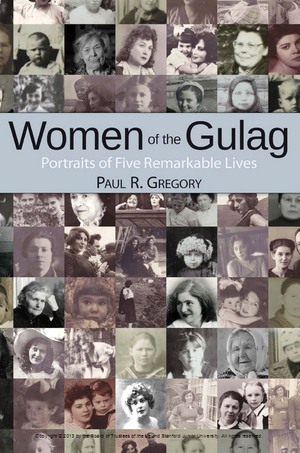 My Hoover colleague and co-author Paul Gregory is involved in a remarkable project: to bring to life the stories of women who survived life in Stalin's Gulag. His book, Women of the Gulag: Portraits of Five Remarkable Lives, recounts their fates. As a historian, Paul began his research from documentary records of the survivors. He went on to track them down. The result is a beautiful and touching feature film by Marianna Yarovskaya.
In 2013 at the Hoover Institution's annual summer workshop I had the privilege to see an early cut of this beautiful film. Introducing Paul and his work to the audience, this is what I said:
For some of you Paul Gregory will need no introduction. For others, he is a leading economist and historian of Russia under communist rule. Among economists he is a rarity. All economists work with theoretical models and statistical data. Paul is one of the few that also understand the power of the story. Among Paul’s most celebrated publications are books that tell stories. His book Lenin’s Brain is a collection of stories from the Hoover Archives that range from the grim to the comic and curious. His book Politics, Murder, and Love in Stalin’s Kremlin is the poignant story of Nikolai and Anna Bukharin.
Today Paul Gregory will talk about his new book, called Women of the Gulag. Women of the Gulag was inspired by a need and an opportunity. The opportunity is represented by the Hoover Archive’s rich holdings on coercion and repression in the Soviet Union. These include millions of pages of documents from the Gulag, Stalin’s agency for forced labour camps. Among other holdings that tell the story of power and cruelty under the Bolsheviks are the minutes of many meetings of the party central committee and the personal archives of Nestor Lakoba, one of Stalin’s Georgian comrades in arms; and of Dmitrii Volkogonov, Gorbachev’s biographer of Stalin. These holdings illustrate the opportunity for scholars to work here at Hoover on the history of Soviet rule.
Now the important bit.
The need for Paul’s book is illustrated by a simple statistical comparison: In Russia, women die on average in their mid-70s, and men in their early 60s. Almost all men who experienced and survived Stalin’s mass repressions are now dead. Only a few women are still alive, and they too will soon have passed on. Their stories need to be told now, before it is too late. Through Paul’s book, the last survivors have now been able to tell their stories. They are: Women of the Gulag.
While Paul's book is published, the film of the book, which includes moving interviews with its surviving heroines, is still to be completed. Paul is crowd-funding this final stage. If you would like the chance to contribute, here's how.
Mark Harrison
10 Oct 2016 15:10
| Tags: Communism Stalin
| Comments (0)
| Report a problem
August 26, 2016
The Cold War: Bridge of Spies, and Other Lost Chances for Peace
Writing about web page http://www.simonandschuster.co.uk/books/Bridge-of-Spies/Giles-Whittell/9781849833271
Were there missed opportunities to unwind the tensions of the Cold War? This question was raised by my holiday reading: Bridge of Spies, by Giles Whittell. The book was published in 2011 by Simon & Schuster. (Since then Steven Spielberg has made a film with the same title. The relationship between the book and the film is currently in dispute. The book is great. I'm told the film is decent, but I haven't seen it yet; my remarks are based entirely on the book.)
The book tells the stories that came together in a prisoner exchange across the Gleinicke Bridge that joined East and West Berlin on 10 February 1962. For present purposes, the story that matters is that of Francis Gary Powers, an American U-2 (spy plane) pilot, shot down over the Urals on 1 May 1960. After parachuting to safety, Powers was captured, put on trial, and imprisoned. The author links this moment to a missed chance for peace in the Cold War. His argument goes like this.
In the 1950s, there was a Soviet-American race to develop long-range nuclear missiles. Both sides had atomic weapons that could be delivered by planes, but planes were slow and could be intercepted. Ballistic missiles would take nuclear attack and counter-attack to a new level: fast and certain. The arms race was becoming more dangerous.
In point of fact, however, in the late 1950s neither side actually had a reliable long-range missile. Rocket science meant filling a giant tube with an oxidizer and an oxidant and setting them on fire in the hope that they would burn smoothly, not just blow up. Mostly they blew up.
There was one difference between the two sides. The American failures were public. The Soviet failures were hidden from view. They were concealed by two things. One was intense secrecy. The other was a veneer of success. As far as both the American and the Soviet publics were concerned, the Soviets were winning the space race. They were first with a space rocket, first with an orbiting satellite (the famous sputnik), and first with a dog in a spaceship, all in 1957. Judged on that basis, the Soviet missile programme was more advanced. In 1958 and 1959 the Soviet leader, Nikita Khrushchev, made several claims of a successful, large-scale Soviet missile programme that strongly reinforced this impression.
Only one of these claims is reported in Bridge of Spies, but they are collated in a declassified CIA report dated 21 January 1960as follows. In November 1958, Khrushchev announced that Soviet intercontinental missile production was set up and ready to go. In January 1959 he repeated this announcement, referring specifically to “serial” production, implying large numbers. In November of the same year, he told journalists: “In one year, 250 missiles with hydrogen warheads came off the assembly line in the factory we visited.” (But he did not state that they were intercontinental missiles.) And, in January 1960, he announced a substantial cutback of Soviet conventional forces, offering as the public justification: “We already have so many nuclear weapons … and the necessary rockets … that … we would be able literally to wipe the country or countries which attack us off the face of the earth” (my emphasis).
(More famously, but less precisely, at a reception held in November 1956, Khrushchev had told the assembled NATO ambassadors: "We will bury you," using the Russian verb for interment of the dead.)
During 1958 and 1959 the Americans who took Khrushchev seriously raised the alarm: there was a "missile gap," they claimed, that US President Eisenhower had allowed to grow from complacency and lack of effort. Eisenhower tried to manage his critics by looking for independent evidence of the true size of the Soviet missile programme. The evidence would come from a secret CIA operation, a squadron of camera-laden spy planes overflying Soviet territory at super-high altitudes, above the reach of Soviet air defences.
In reality, Khrushchev was bluffing America over his WMD programme—a risky activity, as Saddam Hussein would later discover. The huge Soviet space rocket that was lifting satellites into orbit was completely unsuitable for a surprise nuclear attack, as Whittell explains: it "took days to fuel and was impossible to hide." Meanwhile, Khrushchev’s bluff was going wrong: it was stirring the United States into a military-industrial mobilization. If that worked, the Soviet Union would have no choice but to turn the bluff into reality. For the Soviet economy, only a fraction the size of the far wealthier United States, that looked ruinously expensive.
By 1960, therefore, Khrushchev was regretting his bluff. In January he announced a major cutback of conventional forces—justifying it by claims of Soviet nuclear strength. According to Bridge of Spies, moreover, he was preparing a daring initiative to end the missile race—a chance for peace in the gloom of the Cold War. In return for American restraint, he would offer to bargain away something that he didn't actually have: a successful Soviet missile programme. If the Americans would agree not to build missiles, the Soviet side would agree to stand down Khrushchev’s missiles. Without missiles, the balance of terror would recede, and the world would be spared the pointless expenditure of trillions of dollars on nuclear overkill.
What could go wrong? While Khrushchev was forming his plan, the Americans were trying to uncover the truth—and they were beginning to succeed. The CIA spy planes had found most of the Soviet potential manufacturing, test, and launch sites, and there was no sign of hundreds of missiles. Still, the picture remained worryingly incomplete, and the U-2 programme continued.
Then, disaster struck. On May Day, 1960, while Khrushchev reviewed the annual military parade in Red Square, a new Soviet anti-air missile shot down the U-2 flown by Francis Gary Powers. Khrushchev made a huge public fuss. A planned East-West summit was cancelled. There was no Soviet arms control initiative. The missile race went on, and led quickly to the most dangerous moment of the Cold War. This came in 1962 with Khrushchev’s attempt to place nuclear missiles in Cuba.
So, Whittell suggests, the chance for peace was lost. But I began to wonder. My first question was: if a chance was lost, who lost it? That is, who should have behaved differently? Whittel does not criticize the actions of Khrushchev, the Soviet leader, who is portrayed as seeking peace. Nor does he question the decisions made by Eisenhower, the American leader, who resisted the escalation of tensions, and looked to the CIA and its U-2 programme for supportive evidence. As for Powers, he was just a soldier.
Those whom Bridge of Spies holds accountable are the American promoters of the “missile gap” theory: the profit-seeking entrepreneurs (Thomas Lanphier), position-seeking politicians (Allen Dulles and Stuart Symington), and headline-seeking journalists (Joseph Alsop and Frank Gibney) of the US military-industrial complex. Also, let’s not forget the US presidential candidate John F. Kennedy, who campaigned successfully in 1960 on closing the “missile gap.”
Still, one wonders: how should these people have behaved differently? In hindsight they were wrong, and hindsight is a wonderful thing, especially for historians. At the time, however, how should they have known that Khrushchev lied? The Soviet Union was then, as before and afterwards, shrouded by the most intense secrecy the world had ever known. Why, and what did the secrecy conceal? Eisenhower’s intuition was that Khrushchev’s claims were a bluff, but he did not know for sure; that’s why he approved the U-2 spy plane programme. Dulles, Symington, and the others did not know for sure either, but at least they had evidence on their side in the public claims of the Soviet leader himself.
Was there really a lost chance for peace in 1960? As I asked myself this question, I stumbled on a second “lost chance.” This one, from 1953, is claimed by Sheila Fitzpatrick, writing in The Guardian on 18 August 2016. Fitzpatrick, one of the world’s great experts on Stalin’s Russia, was reviewing The Last Days of Stalin, by Joshua Rubinstein, published this year by Yale University Press. This is a book I haven’t read, so my comments are based entirely on Fitzpatrick’s review.
As Fitzpatrick points out, after Stalin’s death in March 1953, the Soviet leaders who succeeded him allowed many reforms to go ahead. Within their country they quickly curtailed Stalin’s last purges, and they went on to the phased release of millions from forced labour and resettlement. (I wrote about these changes in my own book, One Day We Will Live Without Fear.) In Korea, the new leaders allowed ceasefire talks to resume, bringing a speedy end to that bloody conflict.
Could there have been more? Soviet leaders, Fitzpatrick writes, “wanted to signal their interest in easing cold war tensions …. in the crucial months between Stalin’s death in March and the Berlin uprising in June of 1953, the US missed a great opportunity to meet the new Soviet leaders halfway.” She quotes Rubinstein’s verdict: “Soviet and Western governments could not overcome the decades of distrust that divided them.” That suggests equal blame for missing the chance on both sides.
Fitzpatrick answers back: this is too even-handed. Khrushchev looked for an opening. Churchill was ready for a summit. Eisenhower resisted, believing that this might be the time to call on the Soviet people to rise up against their oppressors. Whispering in Eisenhower’s ear was the older Dulles brother, John Foster Dulles, who believed that, eight years after World War II, the Soviet Union presented “the most terrible and fundamental” threat to Western civilization in a thousand years. Responsibility for the missed opportunity to unwind the Cold War in 1953 lies, Fitzpatrick concludes, “squarely with the US.”
So, the hypothesis: two lost chances to scale back the Cold War, one in 1953, the other in 1960.
After much reflection I’m not convinced. Here are my reasons. First reason: pay attention to the inherent fragility of the two Soviet peace initiatives. They were so brittle and insubstantial that, if one obstacle had not broken them, another surely would have. Consider 1953, when a new Soviet leadership wanted briefly to open up to the West. The window opened in March, when Stalin died, but it closed again in June. Why so brief an opportunity? Because, at the first signs of domestic relaxation, thousands of East Germans turned out into the streets to demand the resignation of the communist government. The uprising was promptly suppressed by tanks and guns. Hundreds of people were killed, then or later.
From that moment it was clear that the goals of Stalin’s successors had not changed: to hold power at all costs and spread their system of rule wherever possible. They differed from Stalin only in their preferences over means: “peaceably if we may, forcibly if we must.” Did they really want peace? Not deeply enough to respond peaceably to their own people if there were unintended consequences.
The chance for peace in 1960 was fragile too. It was fragile for two reasons: the Soviet commitment to missile negotiations was only skin-deep, and it was based on a lie. Khrushchev wanted an agreement with the Americans, but how deeply did he really want it? The shootdown of Francis Gary Powers did not stop him from seeking one. The world knew nothing about the U-2 programme until the Soviets publicized it. If they had really wanted a disarmament summit, they could simply have kept the news to themselves. They had the means, after all, in the world’s most effective censorship.
You could say that the Western Cold Warriors, uncomfortable with Eisenhower’s restraint, did not help because they put pressure on Eisenhower, and this put pressure on Khrushchev, which played into the hands of the Soviet military leaders who were already uncomfortable with Khrushchev’s conventional arms cuts. (I’m writing about the Soviet military as though they were a faction, although there is no real evidence that such a faction existed.) But in fact the Soviet side was collectively to blame for all the circumstances in which this game was played out. The Soviet missile men were to blame for a failing programme that threaten to impoverish the country. And Khrushchev was to blame for lying about the programme’s success. If he hadn’t made exaggerated claims, the “missile gap” would never have existed.
Now my second reason: when communist leaders came to the West with peace initiatives, they generally had a vastly inflated belief in their own credibility. They never really got how most Westerners saw them. (But it’s true that Western sympathizers with communism shared the same blinkers.) Within their own countries these leaders, Khrushchev included, were responsible for terrible crimes of commission, arresting and killing millions, and also crimes of omission, allowing millions to die of famine. Afterwards they regretted this, and they made partial, semi-secret admissions, not of personal guilt, but of a few collective errors. Instead of resigning and allowing judicial scrutiny to take its course, their next move was to carry on as normal: So we made some mistakes. We fixed them. What’s done is past. Everything is all right now! Move on. But the world remembered.
In foreign policy, the communist leaders had occupied Poland and the Baltic countries, blanketed them with the same secrecy and censorship that they operated at home, eradicated their national institutions, exterminated their national elites, imposed new regimes, staked out new borders, and defended them with the threat of overwhelming conventional and nuclear force. Because this turned out to be quite expensive, they thought they could then turn on a sixpence and say to the West: lower your guard, because that was then, and now we want peace and friendship. And Western leaders were expected to lower their guard on the word of practised killers who concealed their own weapons under a veil that could be penetrated only by a spy plane at 90,000 feet.
The first and only communist leader to get this was Mikhail Gorbachev. He puzzled over the Soviet Union’s inability to reach new agreements with the West over arms control. Shortly after taking office, on his road to Damascus, in 1986 or thereabouts, he reached an astonishing, shattering conclusion: They don’t trust us because they think we’re liars! And they’re right: we are liars! We can only be credible partners in negotiation if we learn to be open about everything and tell the truth! (Which turned out to be unexpectedly difficult. I wrote part of this story here.)
So my conclusion on the lost chances to end the Cold War is pessimistic. I don’t see real missed opportunities in either 1953 or 1960. On a more optimistic note, there was usually scope for both sides to gain from arms control, and negotiations were generally better than fighting. The important arms treaties would come. But their negotiation required more mutual trust than was available in 1953, and more mutual openness than was available in 1960.
Mark Harrison
26 Aug 2016 14:49
| Tags: Communism Politics Stalin War
| Comments (2)
| Report a problem
June 02, 2016
When Central and Eastern Europe Led the World
Writing about web page https://drive.google.com/file/d/0B7VJ1wykdp_YdXBiT3ZCT3FKNGM/view
Last week I spent a few days in Regensburg, a pretty town in Bavaria. The subject of our conference was the economic history of central, eastern, and southeastern Europe since 1800. The meeting was convened by the excellent Matthias Morys of the University of York; Matthias is editing a book on this theme for Routledge. The general standard of the chapters is going to be exceptional. (I’m not an author; I went along to hear and discuss.)
An important theme of the book will be how central and eastern Europe lagged behind western Europe in productivity and social well-being, and the varying successes and (mostly) failures of the region in closing the gap. This raised a question: Should central and eastern Europe always be judged against western European countries, as though we (the West) set the only standards that count? Shouldn’t everyone try to understand that region in its own terms, without negative preconceptions?
We had reached the interwar period of 1918 to 1939 when a commentator raised this question sharply. It’s a good question, and it brings us in a surprising direction. Think about it: what were the standards that the nation states and regimes of Central and Eastern Europe set themselves, whether in the interwar period or over the last two centuries? Often enough, the answer turns out to be, the goal that they set was to catch up with Western Europe.
At first sight this takes us back to where we started, to the standards of productivity and social well-being set in Western Europe. But this would not be strictly accurate. When the states and rulers of central and eastern Europe set out to catch up, it was not so much in average incomes or welfare, which were not even measured systematically until the middle of the twentieth century. The dimension in which they aimed to catch up was that of national power.
As it turns out, the first decades of the twentieth century were a time of great success for two of the countries of central and eastern Europe in the race to catch up and overtake western Europe in national power. These countries were Germany and the Soviet Union.
National power can be measured, although imperfectly. The scholars of the Correlates of War project set out to measure the global distribution of national power with a “composite index of national capability” (CINC) designed to capture “the ability of a nation to exercise and resist influence.” A country’s CINC score combines six indicators of its relative weight in the international system, year by year: total population, urban population, iron and steel production, energy consumption, military personnel, and military expenditure. On this measure, in 1871, the Russian and German Empires together accounted for one fifth of the total of power in the world (12 percent for Germany and 8 percent for Russia). By 1914, through industrialization and rearmament, they had pushed up their combined weight to more than one quarter (14 percent to Germany, 12 percent to Russia). And by 1940, after more expansion and more rearmament, when Hitler’s and Stalin’s regimes were temporarily in alliance, their share had risen to nearly one third (17 percent to Germany, 14 percent to the Soviet Union).
(For data sources and more context, look at Table 1 of this paper.)
Within 70 years, in summary, the two great powers of central and eastern Europe transferred more than one tenth of global power into their own hands. This was a dramatic shift in the balance of power, and a stunning achievement.
Thinking about this, I said in the conference: You want us to celebrate the aspects in which the countries of eentral and eastern Europe led the world at the time? OK, let’s hear it for autocracy, aggression, and mass killing. I was trying to be ironic, but I wasn’t sure if something got lost in translation.
Of course, you could be central or east European and be happy. Anywhere in the region, most of the time, you could live, love, carry on a trade, make a family, make art, make science, teach, and build. You could try to lead a good life, a life no worse than the lives led by anyone to the West. Bad things might happen to interrupt these efforts anywhere in Europe, west or east. For centuries, however, if you lived to the east of the Rhine, the probability that your efforts would be cruelly ended by young men in uniform under orders from above was much, much greater.
To understand why is the challenge for Matthias and his co-authors..
Mark Harrison
02 Jun 2016 08:00
| Tags: Economics History Hitler Stalin
| Comments (0)
| Report a problem
February 18, 2015
Russia's Improbable Futures and the Lure of the Past
Writing about web page http://rbctv.rbc.ru/polls/list
On 27 January I was asked to join a panel on Russia's Future within the University of Warwick One World Week. (The other panel members were Richard Connolly, co-director of the University of Birmingham Centre for Russian, European, and Eurasian Studies, and the journalist Oliver Bullough.) I decided to talk about how Russians are looking to the past in order to understand their uncertain future. Here, roughly, is what I said:
Russia has many possible futures; all of them are improbable. The economy must do better, stay the same, or do worse. Relations with the West must improve, remain as they are, or deteriorate further. Adding them up, there are nine possible combinations. The probability of any particular combination is small, so each is improbable. But one of them must happen because, taken together, the sum of the probabilities is one. One of them must happen, but we have no idea which one.
Faced with an uncertain future, we often look to the past for guidance and reassurance. What was the outcome when we were previously in a situation that felt the same? At New Year, many Russians were looking to the past. I found this out when I stumbled on the website of RBC-TV, a Russian business television channel. Every day the RBC website polls its fans on a different multiple-choice question. On 30 December, the question of the day, with answers (and votes in parentheses), was:
What should Father Frost bring for Russia?
- End of sanctions (6%)
- End of the war in Ukraine (27%)
- A stable ruble (7%)
- Return of the Soviet Union (59%)
It's disconcerting to be reminded of the strength of nostalgia among Russians for the time when their country was a global superpower. The Soviet Union united all the Russias -- if anyone's not sure what that means, that's Great Russia, Little Russia and New Russia (Ukraine), and White Russia (Belarus) -- with the countries of the Baltic, Transcaucasia, and Central Asia. The Soviet Union stood for strong centralized rule, with a powerful secret police and thermonuclear weapons. The nostalgia is shared by President Putin, who said (on 25 April 2005): “The collapse of the USSR was the greatest geopolitical disaster of the [twentieth] century.”
Here's a question that RBC asked its supporters on 25 December:
Can direct controls and a price freeze save Russia’s economy?
- Yes, the free market is not up to the job (55%)
- No, that would cause insecurity and panic (40%)
- No need – no crisis (5%)
Again, the strength of support for the backward-looking answer is disconcerting. I tried to think of the last time the Russian economy was in a squeeze like today's. The last time the oil price price came down like this was the mid-1980s when North Sea and Alaskan oil broke the power of the OPEC cartel for a few years (that's the analysis of Anatole Kaletsky). The disappearance of oil rents probably contributed to the collapse of the Soviet economy.
But a closer parallel to today is 1930, when two things happened at once. The global market for Soviet exports shrank in the Great Depression. And international lending dried up, meaning that the Soviet economy could not roll over its debts. The Soviet import capacity collapsed almost overnight. Stalin responded by forcing the pace of import substitution through rapid industrialization. He demanded "The five plan in four years!" The result was a crisis of excessive mobilization that claimed millions of lives in the famine of 1932 and 1933.
Prominent in calling for an economic breakthrough today is President Putin, who responded to Western sanctions on 18 September 2014: “In the next 18 to 24 months we need to make a real breakthrough in making the Russian real sector more competitive, something that in the past would have taken us years.” Government-friendly Russian economists are talking about the need to go from a market economy back to a mobilization economy. In case the foreigners aren't getting the message, first deputy prime minister Shuvalov told those assembled in Davos on 23 January: “We will survive any hardship in the country – eat less food, use less electricity.”
A third question that RBC asked its viewers was on 19 December:
What matters most for the country right now?
- The foreign exchange rate (33%)
- Who is a true patriot and who is fifth column (56%)
- “Vyatskii kvas” (11%)
(The English equivalent of "Vyatskii kvas" would probably be Devon cider. For the reasons why it was being talked up as a solution to Russia's problems last December, click here.)
Here the strength of support for the backward looking answer is shocking. What is the "fifth column" and how does it resonate in Russian history? In 1937, Stalin saw Moscow surrounded and penetrated by enemies. This coincided with the siege of Madrid in Spain’s Civil War. In 1936 the nationalist General Mola was asked which of his four columns would take Madrid. He replied, famously: “My fifth column” (of undercover nationalist agents already in the city). In Madrid the Republicans responded by executing 4,000 nationalist sympathisers. In the Soviet Union Stalin, who was also watching, ordered the execution of 700,000 “enemies of the people.”
In recent times, the spectre of a "fifth column" was first reawakened by President Putin on 18 March 2014, when he remarked: "Western politicians are already threatening us with not just sanctions but also the prospect of increasingly serious problems on the domestic front. I would like to know what it is they have in mind exactly: action by a fifth column, this disparate bunch of ‘national traitors’, or are they hoping to put us in a worsening social and economic situation so as to provoke public discontent?"
Putin took up this theme again on 18 December 2014: "The line that separates opposition activists from the fifth column is hard to see from the outside. What’s the difference? Opposition activists may be very harsh in their criticism, but at the end of the day they are defending the interests of the motherland. And the fifth column is those who serve the interests of other countries, and who are only tools for others’ political goals."
Here you can see that Putin did affirm the possibility that opposition can be loyal. But is it possible for Russia to have a loyal opposition today? The only example of loyal opposition that Putin could bring himself to mention was the poet Lermontov -- who died in 1841.
These echoes of the Soviet past in Russian opinion today are disconcerting and even frightening. At the same time it is important to remember that, even while Russians look to the past, Russia today is absolutely not the Soviet Union. From today's vantage point it is nearly impossible to imagine how closed, stifling, claustrophobic, and isolated was everyday life even in late Soviet times. Russians in 2015 lead very different lives from Soviet citizens in 1985. They are richer, live longer, are able to visit, study, phone, and write abroad. Even today they are relatively free to search for and find information and discuss it among themselves. In all these ways, the transition from communism has not been a failure.
As Andrei Shleifer and Daniel Treisman (2014) wrote recently: "Putin’s authoritarian turn clearly makes Russia more dangerous. But it does not, thus far, make the country politically abnormal. In fact, on a plot of different states’ Polity [i.e. democracy] scores against their incomes, Russia still deviates only slightly from the overall pattern. For a country with Russia’s national income, the predicted Polity score [a measure of democracy] in 2013 was 76 on the 100-point scale. Russia’s actual score was 70, on a par with Sri Lanka and Venezuela."
To see Russia as just another middle income country helps us to identify Russia's underlying problem. In Russia, just like in Sri Lanka, Venezuela, and most countries outside “the West,” wealth and power are fused in a small, closed elite, and that is how it has always been. The fusion of wealth and power was and remains normal. Before the revolution Russia was governed by a landowning Tsar, aristocracy, and church. After the revolution Russia was governed by a communist elite that monopolized all productive property plus media, science, and education. Today Russia is governed by an ex-communist, ex-KGB elite that has once again gathered control of energy resources and the media. This fusion of wealth and power is neither new nor is it unusual among middle and low income countries.
In societies where wealth and power are fused, particular people are powerful because they control wealth and the same people are wealthy if and only if they are powerful. This is what gives politics in such societies its life-and-death immediacy. To lose power means to lose everything; when power change hands there is often violence. “All politics is real politics," write Douglas North, John Wallis, and Barry Weingast (2009); "people risk death when they make political mistakes.”
Several times in history, liberal reformers have tried to separate wealth and power in Russia and make space for public opinion. Here are some examples from the last 150 years:
- In 1864 a reform brought elected local governments – but within an absolute monarchy.
- Shaken by military defeats and popular insurrections, in 1906 the Russian monarchy introduced an elected parliament, although with few powers, and ndividual peasant landownership, although (as it turned out) with little time for implementation.
- In 1992 and 1995 Russia saw voucher privatization and "loans-for-shares," creating a class of corporate shareholders – but the outcome was crony capitalism, not free enterprise.
- In 2003, Mikhail Khodorkovskii tried to separate the governance of Yukos from the "power vertical," but he went to prison for it.
All these efforts have so far achieved only partial or temporary success. Russia has not yet found a solution to the problem of the fusion of wealth and power. Here, at last, is an aspect of Russia's future that is certain: If Russia is ever to find a solution to this problem, it will be there.
Note: I updated this column after publication to correct a date -- 2014, which appeared as 1914.
References
- North, Douglas, John Wallis, and Barry Weingast. 2009. Violence and Social Orders A Conceptual Framework for Interpreting Recorded Human History. Cambridge: Cambridge University Press.
- Shleifer, Andrei, and Daniel Triesman. 2014. "Normal Countries: The East 25 Years after Communism." Foreign Affairs, November-December.
Mark Harrison
18 Feb 2015 07:00
| Tags: Economics History Putin Russia Stalin
| Comments (1)
| Report a problem
June 13, 2014
The military power, economics and strategy that led to D–Day
Writing about web page http://theconversation.com/the-military-power-economics-and-strategy-that-led-to-d-day-27663
The Conversation published this column on the seventieth anniversary of D-Day, June 6 2014. I thought I'd include it here.
On June 6, 1944, more than 150,000 Allied troops landed in Normandy. Their number rose to 1.5m over the next six weeks. With them came millions of tons of equipment, ranging from munitions, vehicles, food, and fuel to prefabricated floating harbours.
The achievement of the Normandy landings was, first of all, military. The military conditions included co-operation (between the British, Americans, and Free French), deception and surprise (the Germans knew an invasion was coming but were led to expect it elsewhere), and the initiative and bravery of officers and men landing on the beaches, sometimes under heavy fire. More than 4,000 men died on the first day.
D-Day was made possible by its global context. Germany was already being defeated by the Soviet Army on the eastern front. There, 90% of German ground forces were tied down in a protracted losing struggle (after D-Day this figure fell to two-thirds). The scale of fighting, killing, and dying on the eastern front was a multiple of that in the West. For the Red Army in World War II, 4,000 dead was a quieter-than-average day.
Economic factors were also involved. In 1944 the main fighting still lay in the east, but the Allied economic advantage lay in the west. Before the war the future Allies had twice the population and more than twice the real GDP of the Axis powers. During the war the Allies pooled their resources so as to maximise the production of fighting power in a way that the Axis powers did not attempt to match. America made the biggest single contribution, shared with the Allies through Lend-Lease.
Between 1942 and 1944 Allied war production exceeded that of the Axis in every category and on all fronts. This advantage was especially great in the West. In the chart below, a value of one on the horizontal plane would mean equality between the two sides. Values above one measure the Allied dominance:

Eventually the accumulation of firepower helped turn the tide. A German soldier in Normandy told his American captors, “I know how you defeated us. You piled up the supplies and then let them fall on us.”
D-Day was made possible by economics, but it was made inevitable by other calculations. When the outcome of the war was in doubt, Stalin demanded the Western Allies open a “second front” in Western Europe to take pressure off the Red Army. At this time, working towards D-Day was a price that the Allies paid for Stalin’s cooperation in the war. By 1944 German defeat was assured; now D-Day became a price the Western Allies paid in order to help decide the post-war settlement of Europe.
While D-Day was inevitable, its success was not predetermined by economics or anything else. The landings were preceded by years of building up men and combat stocks in the south of England, and by months of detailed logistical planning. But most of the plans were thrown to the wind on the first day as the chaos of seasick men struggling through the surf and enemy fire onto the Normandy sands unfolded. This greatest amphibious assault in history was a huge gamble that could easily have ended in disaster.
Had the D-Day landings failed, our history would have been very different. The war would have dragged on beyond 1945 in both Europe and the Pacific. Germany would still have been undefeated when the first atomic bombs were produced; their first victims would have been German, not Japanese. Germany and Berlin would never have been divided, because the Red Army would have occupied the whole country. The Cold War would have begun with the Western democracies greatly disadvantaged. We have good reason to be grateful to those who averted this alternative history.
 Mark Harrison does not work for, consult to, own shares in or receive funding from any company or organisation that would benefit from this article, and has no relevant affiliations.
This article was originally published on The Conversation. Read the original article.
Mark Harrison
13 Jun 2014 16:22
| Tags: Economics History Politics Stalin War
| Comments (0)
| Report a problem
March 13, 2014
Stay Where You Are: Russia Will Come to You
Writing about web page http://www.forbes.com/sites/paulroderickgregory/2014/03/10/putins-big-lie-on-ukraine-if-it-werent-so-serious-it-would-be-funny/
An old joke has resurfaced in connection with Ukraine's Crimean crisis. I saw it first in a column by my co-author Paul Gregory:
You want to live in France? Go to France. You want to live in Britain? Go to Britain. You want to live in Russia? Stay where you are: Russia will come to you.
It's generally hard to work out when and where such jokes originated, but this one has real-life foundation.
Before the war Menachem Begin, who was later Israel's prime minister, was a Jewish activist in Poland. When Germany and the Soviet Union divided Poland in 1939 he fled to Lithuania, where Soviet troops arrived in 1940. With thousands of others, Begin was arrested. He was accused of being a British agent under Article 58 of the RSFSR (Russian republic) criminal code, which dealt with counter-revolutionary crimes. In a later memoir Begin recalled a prison conversation (Weiner and Rahi-Tamm 2012, p. 14):
When Begin inquired how article 58 of the Soviet Criminal Code (counter revolutionary activity, treason, and diversion) could be applied to activities that were considered legal in then sovereign Poland, his interrogator did not hesitate: “Ah, you are a strange fellow [chudak], Menachem Wolfovich. Article 58 applies to everyone in the world. Do you hear? In the whole world. The only question is when he will get to us or we to him.”
This raises an interesting question: If the jokes are the same, is the system the same? In other words, is Putin's Russia the same as Stalin's Soviet Union? In most aspects of everyday life the answer is: Clearly not. In Russia today there is far more freedom of speech, assocation, and enterprise than there ever was in the Soviet Union. But there is also much less of these things than there should be. And there are disturbing continuities with the Soviet past in Putin's KGB background and loyalty, his nostalgia for the Soviet empire, and the identification of national power with his personal regime.
Directly linked to these things is continuity in Russia's menacing approach to its neighbours. The people of what was once eastern Poland (now western Ukraine and western Belarus), and Lithuania, Latvia, and Estonia, are being reminded today that they live in territories to which "Russia came" in 1939 and 1940. These occupations were followed by unanimous parliamentary votes and rigged referenda, the registration of the population and issuing of "passports" (ID cards), and mass arrests and deportations.
If we are returning to the past, one may hope for a new era of Russian jokes. Unfortunately, it may turn out that the best jokes have already been told.
Reference
Weiner, Amir, and Aigi Rahi-Tamm. 2012. Getting to Know You: The Soviet Surveillance System, 1939-1957. Kritika 3:1, pp. 5-45.
Mark Harrison
13 Mar 2014 10:28
| Tags: History Putin Stalin
| Comments (0)
| Report a problem
January 08, 2014
Stalin Equals Cromwell: How Putin Sees Russia's Past
Writing about web page http://www.kremlin.ru/news/19859
How is Cromwell so different from Stalin? Can you tell me? There is no difference. From the standpoint of our liberal representatives, from the liberal spectrum of our political establishment, he is a similarly bloody dictator. He was a treacherous guy, and he played an ambivalent role in the history of Great Britain. His memorial stands, and no one is tearing it down.
Russia's President Vladimir Putin does not know the difference between Joseph Stalin and Oliver Cromwell. It is true, as Putin declared (at a four-hour press conference held at the end of last year, on 19 December 2013), that Cromwell was a dictator. It is true, also, that Cromwell's historic achievements were stained with the blood of others. Yet his statue stands in Westminster outside the British Parliament. Putin's implication is clear: Like Cromwell, Stalin is just another national leader from times past, and any nation would be willing to remember him for his place in national history.
What should we take from this? There is a characteristic skew to Putin's view of Russia's past. But this is hardly new. In 2007 Putin had this to say:
As for the problematic pages in our history -- yes, they existed. The same as in the history of any state! Indeed, we have had fewer than some others. And not as terrible for us as in some others. Yes, we had some dreadful pages: let's remember the events that began in 1937, let's not forget them. But there were no less in other states, they've had worse. At least we haven't used atomic weapons on civilians. We haven't flooded thousands of kilometres with chemicals and we haven't dropped seven times more bombs on a small country than were used in the whole Great Patriotic [War, i.e. World War II], as happened in Vietnam, let's say. We've had no other black pages such as Nazism, for example.
You never know what might have happened in the history of other states and peoples! We can't afford to let them make us feel guilty about it -- they should worry about themselves.
In short, Putin does not see much to feel bad about in Soviet public life before 1937. He feels bad about "the events that began in 1937" (when Stalin ordered the execution of 700,000 and the imprisonment of 1.5 million more), but these were no more than would fall into the normal range of bad stuff that might have happened anywhere. I'm not going to go into more detail here on this. Interested readers can go back to the blistering response of Leon Aron, who said it at the time much better than I can.
If "Stalin = Cromwell," what does it matter? One implication might be for Russia's public life, given that Stalin is still politically relevant to Russia in a way that Cromwell is not to the UK. It is three centuries and a half since England's Civil War was concluded and there is no significant Cromwellian party in British public life (other than perhaps in Northern Ireland). Russia today, in contrast, has many active claimants to Stalin's mantle, including a communist party whose leader Gennadii Zyuganov, according to Putin, could be considered as the second figure in Russia's public life. Still, Putin is not calling on Russians to rally under Stalin's banner and return to the peasant-slayer's precepts; far from it.
An alternative implication is the one that matters: Putin wishes Russia's past to be seen as normal. Specifically, a believer in the Russian state and national power, he wishes the history of Russia's state to be seen as continuous and normal. All countries have had their builders of the nation state and its capacity: Cromwell, Napoleon, Bismarck, Ataturk, ... and Stalin. All were forceful modernizers, Putin seems to say, that got their way by imposing sacrifices and crossing the margins of conventional morality. But all deserve their laurels and should have their statues. As for their transgressions, we will not forget to mention "the events that began in 1937," but there's no need to enumerate the mass graves in the birch woods or to detail who killed whom on whose orders.
My guess would be that this view resonates strongly with many Russians today. It's something you can easily lose sight of in Moscow, where most streets and squares lost their Soviet-era appelations and decorations in the early 1990s, and went back to the pre-revolutionary style. But Moscow is not Russia. In many provincial Russian towns the statues of Lenin and other Bolshevik revolutionaries still stand.
A minor detail caught my eye in the reporting of the recent tragic events in Volgograd (formerly Stalingrad): the second (trolleybus) bombing of 30 December took place in the city's Dzerzhinskii district, that is, a part of the city named after Feliks Dzerzhinskii, founder of the Soviet secret police and architect of Red Terror in Russia's civil war. According to Wikipedia, there remain no less than ten Dzerzhinskii districts in Russia's cities and provinces (as well as one in Eastern Ukraine), not to mention the town of Dzerzhinsk, not far from Nizhnii Novgorod. In provincial Russia you can't yet have Stalingrad, despite a campaign to restore Stalin's name to the city, but it's quite normal to have Dzerzhinskii. In Moscow the destruction of Dzerzhinskii's statue was one of the symbolic acts of 1991; recent calls to restore it have evoked polarized opinions.
I thought about this a few months ago when I visited Ekaterinburg. Standing on the edge of Asia, Ekaterinburg is the capital of a province the size of England and Scotland combined, but with less than a tenth of the population. First named after the Empress Catherine the Great, the city was renamed Sverdlovsk in 1924 after the early death of Soviet Russia's first head of state: Yakov Sverdlov. In 1991 the city's pre-revolutionary name was restored, but its hinterland is still called Sverdlov province, and Sverdlov's statue still stands on the main street.

Photo: Mark Harrison.
Ekaterinburg's streets and squares commemorate many figures from the Bolshevik past from Kuibyshev (architect of the first five year plan) and Malyshev (Stalin's minister of the atomic industry) to Michurin (Stalin's pet anti-Darwinian pseudo-scientist) and Serov (first head of the post-Stalin KGB). Oh, and here's the "Iset" hotel, built in the shape of a hammer and sickle in the 1930s as an apartment block for security officials and their families.

Photo: Mark Harrison.
People still call it Gorodok chekistov, the little town of the secret policemen. Elsewhere in the town is Ulitsa chekistov, the street of the secret policemen.

Photo: Mark Harrison
In Ekaterinburg Lenin's statue stands opposite the town hall, just as Sergo Ordzhonikidze's statue stands in the suburbs outside the head office of Uralmash, the giant Soviet-era engineering factory. Ordzhonikidze was Stalin's minister for heavy industry. (He shot himself in 1937 as a protest when Stalin eliminated his subordinates one by one).

Photo: Mark Harrison.
In Ekaterinburg some things have changed since Soviet times, not just the city's name. A mile from Sverdlov's statue stands a new shrine to Sverdlov's most famous victims, Tsar Nicholas II and his family, murdered on the spot in July 1918.
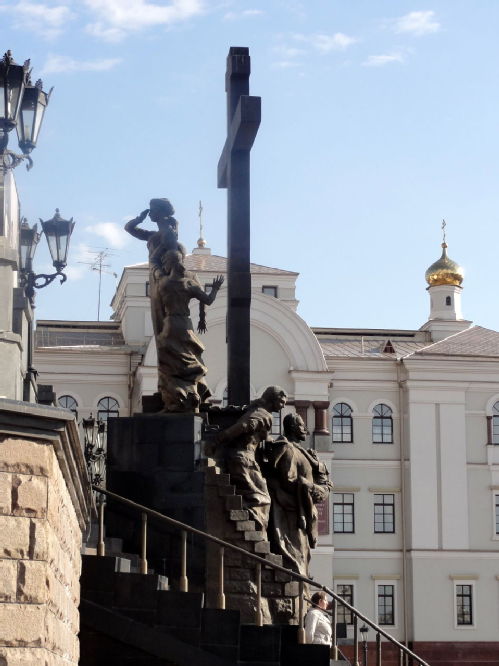
Photo: Mark Harrison
In Ekaterinburg, it seems, perpetrators and victims are commemorated with complete impartiality. The martyr Nicholas gets a new statue, while the likely murderer Sverdlov keeps his old one. It's just like London, where Cromwell's statue stands in Westminster, a short walk from that of Charles I, the King whom Cromwell executed, at Charing Cross.
Not quite like London, though. In Ekaterinburg, something is missing. On a highway a few kilometres out of town, a handpainted sign labelled "Memorial" points off the road. (I didn't get a chance to take a picture.) Memorial to whom? The path leads into the birch forests where the Chekists took tens of thousands for night time execution and burial in the years of Stalin's terror. Mass graves have no importance in Putin's nation-building narrative. They can be forgotten, or filed away under the heading of necessary sacrifices and inevitable mistakes.
This is Putin's view of Russia's past. Sverdlov and Tsar Nicholas; Lenin, Stalin; the Chekists; Kuibyshev, Malyshev, Ordzhonikidze. All are figures from history, state leaders in whom Russians should feel equal national pride. Who can tell the difference? No one. As for the ordinary victims, forget them. Anyway, who cares? Only those that wish to dig for dirt among their bones.
Mark Harrison
08 Jan 2014 10:10
| Tags: History Russia Stalin
| Comments (0)
| Report a problem

 Loading…

