All 46 entries tagged History
View all 182 entries tagged History on Warwick Blogs | View entries tagged History at Technorati | There are no images tagged History on this blog
March 05, 2023
Stalin, Seventy Years On
Writing about web page https://warwick.ac.uk/fac/soc/economics/staff/mharrison/comment/harrison_1979_stalin_centenary.pdf
Stalin died on 5 March 1953 -- seventy years ago today. How should Stalin be remembered? I answered this question once before, in 1979 on the centenary of the Soviet dictator's birth. My article was published in Marxism Today, the monthly "theoretical and discussion jouirnal" of the Communist Party of Great Britain -- of which I was, at the time, a fully paid-up and active member. (I've written more about the communist party and me here.)
If you take a look at my 1979 article, you might be curious about a couple of strange details. One is the date of Stalin's birth, given in my article as 21 December 1879. This date was generally accepted at the time I wrote, but in 1990 it was discovered that in 1920 for unknown reasons Stalin had taken a year off his age. He was actually born on 6 December 1878. The other odd thing is that the article doesn't have my name on it, again for unknown reasons. I was listed as author on the journal contents page, and that's all.
Earlier this year I was prompted to think about how my answer might have changed since then, when someone wrote to me out of the blue.
I have recently read an article on Soviet history in an ancient copy of Marxism today and just wondered if you were the author?
I replied:
Yes, that would be me.
My correspondent came back to me:
I thought it was a very interesting take on the subject and the great majority has stood the test of time.
That sounded nice, but I wasn't too sure. What exactly had I written more than forty years ago? I dug the 1979 original out of my personal archive and read it carefully. Then, I replied:
I thought I had better reread the article before taking your praise for granted. I continued to work on the subject for the rest of my career, which included thirty years in various former Soviet archives dealing with military and economic affairs and internal security). These experiences have perhaps left me with a darker view of the Stalin era (or of the whole Soviet experience) now than I had at the time.
Writing about the Russian Revolution today, I would probably not ascribe agency to the working class as a class (there was plenty of agency, but not of the working class as such).
If Stalin’s rise can be ascribed to an “organic” relationship that he developed with anyone, it was with the party cadres more than the working class.
Turning to the 1930s, what I wrote about a reformist faction led by Kirov was nonsense: as we know now, there were never any disagreements within Stalin’s circle, and no factions whatsoever, only transient personal alliances of convenience that were quickly dissolved as soon as Stalin got to know about them.
I was ignorant of the motives, mechanisms, and scale of the mass purges of 1937-38, and of the extent to which they were started, managed, and then stopped on Stalin’s personal instructions.
I described the “enemies” destroyed by the purges as “non-existent” because I had not fully understood Stalin’s anticipation of war nor had I come across his belief that Soviet society was full of “unconscious” or “potential” enemies who would become traitors when war broke out. I had not really grasped how Stalin thought he could identify the potential enemies based on family background and social and ethnic markers. I was unaware of Stalin’s rule that it was better to kill 20 people than to let one spy get away and I did not understand the encompassing Soviet definition of a spy.
I skated past Stalin’s role as Hitler’s accessory in starting World War II.
I overstated Stalin’s postwar efforts to return Soviet society to its prewar mould: by 1945, we now know, Stalin was physically no longer able to control everything as he had done before, and this set many changes in motion that would become fully apparent only in 1956.
Finally, I did not stress enough what is suggested by the article’s illustrations (which I did not choose): military power-building (which long pre-dated Hitler) and the comprehensive militarization of Soviet society.
Of course, I wrote what I wrote. I’m pleased if I got anything right, and I’m also pleased if it was possible to learn from my mistakes. You can decide for yourself whether the points above count as minor or major corrections.
I went on to explain the circumstances under which I wrote the article.
The article has a back story that is not completely without interest. As you say, Monty Johnstone was the party’s premier expert on the Soviet Union, and I joined the party only after meeting him in London and spending a day talking with him. Others of his generation included the economist Maurice Dobb, Dennis Ogden (who had reported for the Morning Star from Moscow in the 1960s), Brian Pollitt (son of Harry Pollitt, the party’s general secretary from 1929 to 1960), and Pat Sloan, who had visited Russia on a number of occasions. In my slightly younger generation, several others had similar interests: Jon Bloomfield, Geoff Roberts, Jan Sling, and Ken Spours to name a few. (Also Julian Cooper, but our perspectives had less in common then than now.) We had encouragement from Monty and Dennis.
The thing is that the British party leaders were very sensitive to what could be written about the Soviet Union -- and by whom. In 1975 or thereabouts I submitted an article to James Klugmann, then the editor of Marxism Today, for publication on the twentieth anniversary of the twentieth Soviet party congress. The article never appeared, and I no longer have a copy. When the occasion arrived, Marxism Today published another article, this one written by John Gollan (the general secretary who succeeded Pollitt). Gollan’s article included a number of passages using my words. It turned out that Klugmann had shared my draft with Gollan, who borrowed from it. At first my nose was put out of joint, but Klugmann explained to me that this was politics, and I should take it as a compliment. Anyway, I took advantage of the next anniversary (I don’t recall if it was on Klugmann’s initiative or mine) to send in the article that you have to hand.
The one thing missing from this explanation is something that I knew perfectly well but had momentarily forgotten: by the time of my 1979 article, James Klugmann had stepped aside from Marxism Today and Martin Jacques had taken over as editor, so it was thanks to Martin that my article was accepted and published.
 Mark Harrison
05 Mar 2023 08:00
|
Mark Harrison
05 Mar 2023 08:00
|  Tags: Communism History Marxism Politics Russia Stalin
|
Tags: Communism History Marxism Politics Russia Stalin
|  Comments (0)
|
Comments (0)
|  Report a problem
 Please wait - comments are loading
March 22, 2021
When Three Wars Collided: Moscow, April 1982
Writing about web page https://warwick.ac.uk/fac/soc/economics/staff/mharrison/moscow1982/
This column is about a moment when three wars collided: the Cold War, the Second World War, and the Falklands War. It was April 1982; the Cold War was in full swing, and East-West relations were not in good shape. I was in Moscow for a month, thanks to the British Academy's exchange programme with the Soviet Academy of Sciences; I was engaged in a project on the Soviet economy in the Second World War. As I arrived, the Falklands War broke out.
The events that led directly to the Falklands War were taking place as I left the UK. But I had paid little or no attention, so I arrived in Moscow more or less unaware that the Falklands Islands were a British possession, that their sovereignty was disputed, who lived there, and even which hemisphere or ocean they were in. Once in Moscow I was pretty much on my own, with no access to Western radio or newspapers, and I was busy, so I did not even try to follow the news. All in all, I was the last person to find out.
The first I knew of the conflict was a chance remark at the Institute of USSR History, where I was visiting – someone I knew distantly broke into a conversation in a corridor to as: "Why is your country at war with Argentina?" I had absolutely no idea what he was talking about. As I recall, I thought it must be some obscure Soviet joke that I did not understand, so I probably smiled enigmatically and carried on with the conversation as before.
After that, I tried to catch up. But my only source was Pravda, the daily party newspaper. In the first days of the conflict, the Soviet line was strongly anti-imperialist and pro-Argentinian, so they called the Falklands the Malvinas, and they portrayed Argentina as helping the Falkland Islanders to free themselves from colonial oppression and exploitation. I picked up the idea that the islanders were originally brought there as plantation slaves.
After a few days the line shifted. I don't know why, but the Soviet stance became more neutral. The press began to refer to the "Falklands/Malvinas" and, most importantly from my perspective, to report developments from both sides in a more objective way. So I began to get a more accurate fix on what was going on.
In the midst of all this I continued to work on my project, which was on Soviet economic planning in the Second World War and would lead eventually to my first book. Something I was trying to puzzle out was the reliability and consistency of the Soviet official measures of the scale of the war effort. In those days there was absolutely no question of getting archival access to such information, so I had spent a long time combing through all the Soviet publications on World War II and putting together all the data I could find. Not surprisingly, I was left with a lot of questions: things like the concepts and methods used to calculate the growth and scale of Soviet war production, the proportions of resources used for the war, the squeeze on wartime consumption, the role of Allied aid, and so on. The reason I wanted to do this was to be able to make more accurate comparisons of how the different countries fought the war.
I hoped that in Moscow I might find some answers. Of course, I knew that all this information was quite sensitive. I also knew that the Soviets were very proud of their war effort, but I did not see any way in which my digging away would threaten that. With that in mind, asking for help seemed reasonable to me.
In the Institute of USSR History I was attached to the sector on military history. I had a number of interesting conversations there, but i did not get any help with my data issues. When I raised this, I was told: You'd better talk to Mitrofanova.
Avgusta Vasil'evna Mitrofanova was a well-known figure; she'd written the definitive history of the Soviet working class in the war, and at least some of the figures I was puzzling over came from her big book (published in 1971), so this seemed like a good idea. A meeting was arranged. As I was not completely confident in my Russian, I wrote my questions down.
The afternoon of our meeting came around. We met at the institute in a large, rather dingy room. Avgusta Vasil'evna (as I called her, respectfully) was in her early sixties. After all this time I couldn't give much of a description, but I remember a trim lady with an authoritative manner and unshakeable self-possession. There was no small talk. I described my project, and I explained that I had a bunch of unresolved questions which I'd written down, and I passed her the list. She took it and read it. Then, she looked up at me. She said:
Mr Harrison, tell me. Are you an economist, or a historian -- or what?
This was not a good start. Not everyone will recall the atmosphere of the time, but the Cold War meaning of "or what" was perfectly clear to me in that moment. She was asking me if I was a spy. I replied politely. I said that I was a scholar, an economist by training, and my field was economic history: I was an economic historian.
Her next question:
Mr Harrison, who told you to work on these questions?
She might as well have asked who put me up to it. I explained that it had been my decision: no one had assigned the topic to me. She gave me to understand she didn't believe me; I was too young and too junior to choose my own research. Afterwards I remember figuring out that perhaps she was just thinking on Soviet lines. If I'd been a young Soviet scholar, I wouldn't have had the authority to define my own project. My department or sector would have had a plan of work, agreed with the administration and the party committee, and I would have been assigned a part of that plan. Anyway, her implication was that I was really just a hired investigator.
By then I knew I was in trouble. I would have continued to argue my case, but she said to me:
Mr Harrison, I don't know the answers to your questions.
And, if I did, I wouldn't tell you.
After that, there were no more questions. Instead, she gave me a lecture. As I recall, it went on for well over an hour, maybe an hour and a half. It certainly felt like a long time. The highlights that I can remember were the great sacrifices of the Soviet people in the war, her own personal sacrifice (her husband was killed in the defence of Moscow), the huge costs of the war effort, the deaths, the destruction, the homeless refugees, the struggle for postwar recovery. I wondered what I could say. Then I realized there was no point my saying anything. I was not expected to respond.
When Mitrofanova reached her conclusion, I nearly tried to prolong the discussion. I think she'd gone back to the iniquities of capitalism and the shirking and backstabbing of the Soviet Union by the wartime Allies. Her final words were:
But, you see, ours is a different social system. We don't need other people's islands.
Ah! I thought. Now we're back in the present, and she's thinking about the Falklands. But me, I'm thinking about an interesting analogy: If yours is a different social system, why does the Soviet Union continue to hold onto the Kurile Islands and Southern Sakhalin, which historically belonged to Japan but were occupied in the final days of World War II and never returned? That's a great question! Why don’t I ask her?
Perhaps better not. My desire to escape from the room defeated my curiosity. I held my tongue. The meeting was over. Mitrofanova swept out through the door, and I strolled after her into the bright sunlight and the warm breeze of an April afternoon.
Avgusta Vasil'evna Mitrofanova lived for another 30 years, dying in 2003 according to an obituary that I found online. She was born in Akmolinsk in 1910. Her childhood and adolescence were marked by war, revolution, civil war, and famine. Evidently a true believer, she became a party worker in the press and a party lecturer; that's how she passed the years of collectivization, more famine, rearmament, terror, and war again. A woman in a man's world, she successfully converted her skills to scholarship, at least as the Soviet Union understood the term.
In our only meeting she was condescending and confrontational, but in the Soviet Union it was often hard to know who was sincere and who was just playing the role that the situation required of them. Maybe the circumstances and timing of our meeting were sure to provoke an East-West confrontation. Maybe in less formal circumstances or at another time she'd have looked for some common ground. But I think she probably meant every word.
One thing that never occurred to me was to say to her: Why are we fighting? Aren't we both on the same side? For, like her, at that time I was a communist party member. All I can say is that it didn't feel as if we were on the same side. Her communism wasn't mine, and I didn't want to pretend it was.
As for the questions on my list, I had to wait another ten years. In April 1982, the country was on the edge of change. Most of the top party leaders were near the end of their biological lifespans. Leonid Brezhnev was 75 and obviously ill. He died before the end of the year. The Politburo voted twice for continuity, appointing first Yurii Andropov (who died in 1984), then Konstantin Chernenko (who died in 1985).
At last the Politburo bowed to the inevitable, turning to the next generation in the person of Mikhail Gorbachev. After several years of attempted reforms, Gorbachev surrendered the party's monopoly of power. It turned out there was nothing else to the pillars holding up the temple, which collapsed. In 1992 the secret archives were opened, and I found my answers (the result was another book).
In 1982 the spring weather was beautiful. During my time in Moscow I walked around with a camera in my pocket (an Olympus Xa-1 or Xa-2, I think) and I took a ton of photographs. I walked a lot around Oktyabr'skaya square, where I was staying, the roads to the city centre, and a few other places. I remember a disused monastery, a visit to friends in the suburb of Sviblovo, and a short trip out of town to the flea market in Malakhovka.
Recently I noticed that my photos were fading. I decided to scan them and to put them online as my record of Moscow towards the end of the Cold War, on the edge of unimaginable changes.
Mark Harrison
22 Mar 2021 09:30
| Tags: Communism History Politics Russia War
| Comments (0)
| Report a problem
April 28, 2020
Dazed and Confused in the Cold War
Writing about web page https://warwick.ac.uk/markharrison/papers/there_was_a_front_ver_6.pdf
For a few months in the 1970s I was a graduate student in Moscow. Capitalism and communism were fighting the Cold War. What was it like? I was dazed and confused. Now I've written a short memoir of that time. It covers cultural exchange, learning Russian, travelling to Russia, making wonderful friends, learning about informers and surveillance, feeling my way through Soviet academia and economic thought, being misunderstood, trust and mistrust, and travelling for work and for leisure, including my epic visit to a collective farm near Voronezh. I include a few photos from the time. Also, I reflect on what we know now about the Soviet system that I didn’t know then.
My memoir is called: “There was a front, but damned if we knew where.” To explain why, here is an excerpt from towards the end, a section that describes my homecoming. If you want to read more, the full version is here.
It was time to leave. I booked a train ticket on the direct service from Moscow to London, three days and two nights via Warsaw and East Berlin, including a Channel crossing by boat from the Hook of Holland to Harwich. Out of interest, I added on a 24-hour layover in Warsaw – my only visit to another East European country under communism.
I was sad to leave but I was also tired and ready. It was a long journey and I would sit the whole way in a shared compartment. There was some small talk in the carriage, but the countryside was flat and monotonous, and the hours of daylight were few.
At the Soviet border, the whole train was raised off the track while the broad-gauge bogeys were removed and replaced by standard-gauge for the remainder of the journey. While this was done the carriages were inspected inside and out, under and over, by the Soviet border troops, looking for contraband manuscripts and Soviet citizens who for any reason did not want to live out the rest of their lives in the socialist paradise.
In Warsaw, I wandered around the old city, meticulously restored after the war. The only language I had in common with most Poles was Russian, which did little for friendship.
Berlin was shocking. The train rolled through the divided city in the middle of the night. I blinked at the sudden passage from the darkened East to the bright lights of West Berlin. We did not stop, and the lights went out again after a few minutes because West Berlin was an island, and the train rolled back over into the Eastern zone.
As with the journey out, it was better to travel than to arrive. Adjusting to home life was hard. It was hard for me and I’m sure I did not make it easy for others. Time had not stood still while I was away. My friends and loved ones had as much stored up to tell me as I had to tell them. The Britain to which I returned was not the normal country of the anecdote; it was preoccupied with its own class struggle. Many of my friends were warriors for social justice, and I aspired to be one too. To some the Soviet Union was a distraction; to others, it was “my enemy’s enemy” and therefore perhaps a friend. Their appetite for my stories was limited.
For weeks I dreamed about Moscow night after night. In my dreams Moscow was dark, confusing, and utterly strange; I was lost in it and could not find my way back. I saved myself by pouring everything into finishing my dissertation. Looking back, I am reminded of the words that Joan Littlewood put in the mouths of the soldiers returning from the Great War:
And when they ask us,
How dangerous it was,
Oh, we'll never tell them,
No, we'll never tell them:
We spent our pay in some café,
And fought wild women night and day,
’Twas the cushiest job
We ever had.And when they ask us,
And they're certainly going to ask us,
The reason why we didn't win
The Croix de Guerre,
Oh, we'll never tell them,
No, we'll never tell them
There was a front,
But damned if we knew where.The Cold War was not the Great War, and we were not soldiers. In Moscow no rockets flew nor bullets winged. The hazards we faced were only moral. Still, I had been to the other side, and I had returned, and I couldn’t explain it, even to myself. It changed my life. I spent the decades from then to now trying to understand where I had been and to come to terms with it. I am still trying. The only ones to whom I had nothing to explain were the former comrades-in-arms who had been there too, whose lives were also changed, just as surely as mine. So, I was not alone.
Mark Harrison
28 Apr 2020 13:52
| Tags: Communism History Politics Russia
| Comments (2)
| Report a problem
March 13, 2020
Communist Luxury; or 'You complete idiot, do you think we all want to look the same?'
Writing about web page https://www.thebritishacademy.ac.uk/fellows/maxine-berg-FBA
Recently I was asked to say a few words at a conference held to celebrate the career of Maxine Berg, who is one of the world’s best early modern economic historians. I was on a panel about the links between economics and economic history. A theme of Maxine’s recent research in economic history has been luxury in the seventeenth and eighteenth centuries, and especially the production and consumption of luxury objects. I thought of contributing to the occasion by saying a few words about luxury objects in another setting and in a much more recent period: the Soviet Union under communist rule.
A thing can be more than a thing
First, what should economists learn from Maxine’s writing about luxury objects? We learn, first, that a thing is much more than a thing. When we acquire a thing, we do not just acquire the thing itself, or the use of it. We also gain access to the feelings that go with owning it or using it and these feelings can be powerful factors in our choices and our behaviour.
Maxine has written about the many feelings associated with luxury objects. From one angle, they evoke “the vices of luxurious excess”: gluttony and greed. From another angle, they bring us “modern comfort and convenience, enjoyment and sociability, taste, aesthetics and refinement.” From a third angle, they raise questions about “individual and national virtue, the canons of taste, definitions of the self.”
In economics we often refer to concepts of self-interest and of stable preferences as drivers of human behaviour. Increasingly, modern economists also ask questions about the identity of the self that is self-interested; that is, self-interest may not be primitive, but may be formed in association with our feelings of identity. The idea of self implies individual difference, and this leads naturally to the question of how we differentiate ourselves from others in society through the things we consume. The evolution of style and fashion shows that our preferences are not as fixed or stable as economic theory would once have liked them to be, and economists increasingly ask questions about how preferences are formed and what economic and social pressures might cause them to change. In all of these respects, the study of luxury objects suggests fascinating lines of inquiry.
There is more. If we spend a few minutes thinking about luxury objects under communism, we’ll find that they take us in a nearly straight line to the dark heart of the Soviet system of power.
As an exchange student and later a young scholar in Moscow during the Cold War, I saw among my Russian friends a longing for luxury (the Russian words were roskosh’ or uyutnost’) that would have been immediately familiar to Maxine and her team of collaborators, working on luxury in a much earlier period. The people in my own circle showed a yearning for something more than the basic standardized means of life. They sought out small luxuries that would provide some kind of individual difference or distinction. They were fascinated especially by foreign objects of luxury, which were rarely encountered other than at second-hand through the censored media and were therefore novel and unfamiliar by definition.
I was a foreigner: what foreign goods did the Soviet people around me seem to aspire to? Denim jeans, leather goods, cosmetics, handbags, electronic goods, and also images of foreign life including Western-branded plastic carrier bags. Invited to dinner, more than once I bought a bottle of wine or vodka at the local liquor store and carried it to the apartment of my hosts in some plastic bag that had found its way from England into my luggage. When I arrived, the bottle would be accepted with a conventional thank you. The bag it came in would be snatched out of my hands, smoothed carefully, folded with precision, and placed to one side for future use on special occasions. Such things were so much more than "just things."
Approved luxury
The Soviet social order was designed and managed by a power-building party elite who believed that power lay in the production of things – especially motors, planes, tanks, and guns. These were things, too, but, like luxury objects, they were also more than just things. Like luxury objects, rockets and tanks were also valued for their capacity to evoke feelings. Unlike luxury objects, however, the feelings were of national pride and power on one side, and fear and submission on the other.
This vision of society was not just for the elite. It was for the masses too. The masses were supposed to be included into this vision of a powerful modern nation through pride in the Soviet state and party, reinforced by gratitude to the ruling party for the provision of standardized, affordable, basic household goods and services.
Within that somewhat Spartan vision, luxury did play a role. More precisely, there were two kinds of luxury, one approved and permitted, the other censured and restricted to the greatest degree possible.
Approved luxuries were goods that would encourage hard-working families to aspire to a simple, healthy, educated way of life topped off with the elements of modernity: a cooker (later a fridge, washing machine, and vacuum cleaner), soap and basic cosmetics, books and a display bookcase, pictures and family photographs, a telephone, a radio (later TV), a samovar (later an electrovar), patterned china, patterned wallpaper, household ornaments, a bicycle (later a motor car) – all Soviet made, allowing limited scope for distinctions of taste and elegantnost’ – another Russian word but interestingly one with an obvious foreign origin.
Such things were not just things; they were supposed to make you feel proud, especially given that (as everyone knew from the novels of Dickens) working families in the capitalist West lived in poverty and children went barefoot.
These notions of luxury went back to the 1930s when the Stalin regime began to design the legitimate aspirations of young, skilled, highly productive workers – the Stakhanovites. You work hard and fulfil or overfulfil the quota, so you get a bonus – but what’s the point if there’s nothing to spend it on? The 1930s answer was: spend it on permitted luxury. That was then, but it was followed by the war and a 20-year pause of living standards, so permitted Soviet luxury was not remotely widespread until the 1960s.
The approved luxuries were priced to be within the budget of a skilled worker household, but from in the 1950s even through the 1980s they remained in chronically short supply. Worst in that regard were apartments, cars, and phones, for which waiting lists ran to years or decades; a second-hand car could cost you much more than a new one, regardless of condition.
The effect of chronic shortages was that, if you met your friend in the street and saw they had acquired something desirable or pretty or unusual, you did not ask: — Where did you buy that? That was not even a question, because you already knew it could not be bought. So instead you asked, with a lowered voice: — How did you get hold of that?
And the answer to that question was that your friend got hold it either through “special distribution,” which allowed them to exercise the privileges of party membership or key-worker status, or else they had worked their connections to some semi-legal or even criminal under-the-counter network.
Forbidden luxury
From another world, there were also forbidden luxuries. Foreign literature, clothes, cosmetics, and electronic goods were available only to people with privileged access, or with private connections to foreigners, which were discouraged.
This might make you wonder how the forbidden luxuries were different from the permitted ones. The answer is that the permitted luxuries were on sale to domestic residents in government outlets – in principle. (Just not in practice, the shelves being bare for the ordinary shopper.) The forbidden luxuries were not available in that way, even in principle.
In rare cases a few forbidden luxuries could be found on sale in the so-called “currency stores.” These stores were not open to the public. Ordinary people could not see them and did not know they were there. Their street doors were unmarked and their windows were curtained. No one was admitted who could not show papers proving their right to hold foreign currency. On sale inside, along with caviar, cameras, furs, and the best vodka, could sometimes be found the works of Akhmatova, Pasternak, and other "edgy" authors, whose works were printed and published in the Soviet Union but sold only to the export market. Because I was a Westerner with foreign currency in my pociet, I could go in and buy them; occasionally my friends would ask me -- beg me -- to get hold of copies for them, which I did gladly.
Another way in which the forbidden luxuries were different from the approved ones is that you were not supposed to show interest in them or accept them, even if offered.
The forbidden luxuries were proscribed because they were so much more than just things. They too evoked feelings, but these were feelings that the party and state stigmatised as disruptive and dangerous: desire to escape the limitations of Soviet life, admiration of foreign technologies, and interest in Western ideas of free choice (which the Soviet press would call "so-called 'freedom'"). For this reason, the loyal citizen was expected to spurn them. When this did not happen, the KGB would regularly pull in people who praised Western consumer goods or the quality of foreign cars (not for a beating, but at least for a ticking off).
Everyone belonged to the mass
This was how the ruling party controlled Soviet identity: everyone could aspire to Soviet luxury, but only if it was the same luxury for all. In luxury, people could find distinctions, but only within the narrow limits permitted by the ruling party. Beneath that, everyone belonged to the mass.
In conversation with a female acquaintance, I once remarked: — Sitting on the Moscow subway, I like it that I can look around and not know who’s rich or poor. People dress the same. My friend replied, or rather she shouted back at me: — YOU DON’T UNDERSTAND! YOU COMPLETE IDIOT, DO YOU THINK WE ALL WANT TO LOOK THE SAME? THE UNIFORMITY THAT YOU LIKE IS FORCED UPON US. WE HAVE NO CHOICE.
From this I understood that beneath the surface of uniformity, there was a deep inequality that was hidden from the naïve observer. There was inequality of choice. Even more, there was inequality of power. The aspirations of millions were restricted by the self-interested decisions of a tiny, power-building elite. It’s something I think about when I come across complaints that today’s formerly communist societies used to be so much more equal than they are today.
Anyway, the point of this story is to confirm what Maxine Berg has already proved to us with such talent and energy, that the origins of modern luxury and the attributes of luxury objects are fascinating and well worthy of the attention of both economists and economic historians.
Mark Harrison
13 Mar 2020 08:00
| Tags: Communism Economics History Luxury
| Comments (0)
| Report a problem
August 24, 2018
Going Viral: How a Dictatorship Suppresses Ideological Infection
Writing about web page https://www.rfa.org/english/news/uyghur/infected-08082018173807.html
Sometimes it is said that a popular image or tweet or a video clip has "gone viral." That means that it has been shared from person to person many times, like an infection.
When we use this image, we think of ideas spreading on an epidemiological model. Some people have little resistance and so they are highly vulnerable. After just one exposure, they are taken over by the idea and become carriers. Then, they pass it on to more people like themselves who are also of low resistance. A pool is formed of people who pass the idea in question backwards and forwards and, in the process, expose many others. These others might be more highly resistant, and are captured by the idea only after repeated exposure, which happens over a period of time. Eventually, as more and more people are exposed more and more times, the infection will spread to everyone who is not for some reason immune.
The same model, according to which ideas spread like a disease, is often found in the practical thinking of authoritarian regimes. Such regimes often prescribe a particular set of ideas as "healthy" -- for example, obedience to the state and loyalty to the ruler, each embodying or personifying the nation. A source of danger to the regime is then the spread of "unhealthy" ideas, which might encourage disrespect of authority or public demonstrations of discontent. They worry that ideas about free speech or the accountability of rulers, if unchecked, might go viral, undermining the stability of the regime.
The epidemiological model also prescribes the remedy. Risks to public health are contained by keeping the community under continuous surveillance, by quickly identifying outbreaks of disease, and stepping in immediately to isolate the people who have become ideologically sick, preventing them from passing on their infection more widely.
This remedy can be seen at work today in China's province of Xinjiang, where the Chinese state is trying to manage the largely Muslim ethnic minority of Uighurs. On August 18, The Economist reported:
During the past year campaigners, academics and journalists have been shedding light on the detention for “re-education” of vast numbers of ethnic-Uighur Muslims in China’s far-western province of Xinjiang. On August 13th the topic was raised at the UN, when experts undertaking an audit of China’s policies towards ethnic minorities said they had heard that as many as 1m Uighurs are being locked away.
The Economist's report went on to cite a recording by the Xinjiang Uighur Autonomous Region communist party youth league, made last year and published on WeChat. The full transcript can be found on the Radio Free Asia website, and that's where I have taken the following excerpt:
In recent times, amid a growing heavy crackdown, a small number of people—particularly young people—have gone to re-education camps to study. However, their parents, friends and relatives, and the general public don’t understand the benefits of re-education, and as a result they are worried and fearful. So let us give answers to their questions and their concerns today.
Members of the public who have been chosen for re-education have been infected by an ideological illness. They have been infected with religious extremism and violent terrorist ideology, and therefore they must seek treatment from a hospital as an inpatient. In recent years, there have been violent incidents occurring in Xinjiang, one after another, instigated by the “three evil forces [of “terrorism,” “religious extremism,” and “separatism”], which has threatened the safety of people from all ethnic communities and caused serious damage and losses. These terrorists have one thing in common: they were infected by religious extremism and a violent terrorism disease.
The religious extremist ideology is a type of poisonous medicine which confuses the mind of the people. Once they are poisoned by it, some turn into extremists who no longer value even their own lives … If we do not eradicate religious extremism at its roots, the violent terrorist incidents will grow and spread all over like an incurable malignant tumor.
Although a certain number of people who have been indoctrinated with extremist ideology have not committed any crimes, they are already infected by the disease. There is always a risk that the illness will manifest itself at any moment, which would cause serious harm to the public. That is why they must be admitted to a re-education hospital in time to treat and cleanse the virus from their brain and restore their normal mind. We must be clear that going into a re-education hospital for treatment is not a way of forcibly arresting people and locking them up for punishment, it is an act that is part of a comprehensive rescue mission to save them.
In order to provide treatment to people who are infected with ideological illnesses and to ensure the effectiveness of the treatment, the Autonomous Regional Party Committee decided to set up re-education camps in all regions, organizing special staff to teach state and provincial laws, regulations, the party’s ethnic and religious policies, and various other guidelines. They mobilized the public to learn the common language [Mandarin Chinese], complete various technical training courses, and take part in cultural and sport activities, teaching them what is correct and incorrect … so they can clearly distinguish right from wrong … At the end of re-education, the infected members of the public return to a healthy ideological state of mind, which guarantees them the ability to live a beautiful happy life with their families.
Ideological illnesses are the same as physical illnesses, in that they must be treated in time, and should never be ignored and allowed to become serious. Otherwise, later we will regret it, as it will be too late … Being infected by religious extremism and violent terrorist ideology and not seeking treatment is like being infected by a disease that has not been treated in time, or like taking toxic drugs … There is no guarantee that it will not trigger and affect you in the future. If people don’t attend re-education class because there is no one to take responsibility for the household chores, or if they choose to run away from re-education, that can be considered being very irresponsible to themselves, their families and society.
You can see that the Chinese communist party youth league's model of the spread of ideas, expressed in this long quotation, is not intellectually consistent. The unhealthy ideas are sometimes called a "virus," sometimes a "poisonous medicine." But the general idea of ideological infection could not be clearer: "Ideological illnesses are the same as physical illnesses."
One feature of this perspective is that people who have been infected are not to blame (unless they refuse treatment). Another is that they are not seen as lost to the community; they can be saved (or they must help to save themselves). Nonetheless, as long as they are inflected by unhealthy ideas, they are a danger to the community as well as to themselves -- even if they are legally innocent of any crime. Therefore, compulsion is justified to treat them.
PS
Why am I interested? In another context, the Soviet KGB (security police) used the terminology of "unhealthy" ideas and behaviours, and of methods of "prophylaxis" (a medical term for prevention), all the time in internal correspondence and reports. If you would like to read more about this, there are some human-interest stories and more discussion in my book, One Day We Will Live Without Fear, especially chapter 5.
Mark Harrison
24 Aug 2018 20:02
| Tags: China Communism History Politics
| Comments (0)
| Report a problem
October 28, 2017
The Soviet Economy Collapsed After the World for Which it was Designed Disappeared
Writing about web page https://www.elindependiente.com/opinion/2017/10/28/por-que-colapso-la-economia-sovietica/
This column appeared (in Spanish) on 28 October on the website of El Independiente.
Soviet economic institutions were inspired by two western economic models of the early twentieth century. One was the German war economy of the Great War, which Lenin observed and admired for its government priorities, the control of supply chains by committees of industrialists, the rationing of commodities at fixed prices, and obligatory labour mobilization. The other was the American system of mass production of standardized products in great factories under centralized management.
Combined with an authoritarian single-party dictatorship, these two models made the Soviet economy as it emerged under Stalin and persisted until 1991. Everything was designed for mobilization, production, accumulation, and expansion. To ensure this, the state owned nearly everything and directed nearly everything from the centre, either by decree or by pressure to conform, backed up by the secret police. The citizens were motivated to comply with authority by a mixture of patriotic appeals, fear, and meagre rewards. The economy could supply basic consumer goods and services, but its special advantage lay in supplying the means of national power in the world, especially a mass army with vast quantities of standardized weapons. By the outbreak of World War II, Stalin’s Soviet Union had become one the world’s two leading producers of armaments, the other being Hitler’s Germany.
The Soviet economy was capable of growth, but it never proved capable of catching up with the innovative market economies of the time. Moreover, the growth rate of the Soviet economy steadily deteriorated through the postwar period. From the mid-1970s, the Soviet Union was falling further behind the United States in productivity and prosperity. While its economy began to stagnate, the Soviet Union faced additional challenges of the time. One challenge arose from the U.S. rearmament under Presidents Carter and Reagan. Another arose from the self-imposed burden of the Soviet Union’s entanglement in Afghanistan. In the international economy the Soviet Union was reliant on the oil market, where prices collapsed.
The Soviet leaders made repeated efforts to overcome economic constraints through reforms. The reforms sought to raise productivity by decentralizing management and improving incentives for efficient behaviour, while retaining the framework of state ownership and the party monopoly of power. All such reforms failed, as the economy reverted to its basic type. Later, the Chinese leader Deng Xiaoping would say that the last Soviet leader, Mikhail Gorbachev, was a fool for abandoning the party monopoly of power without reforming the economy. But this was unfair. Gorbachev did so only after all economic reforms had been tried, including most of the reforms that had been tried out successfully in China. Why they failed in the Soviet Union is an important story, but one for another time.
The end of the Soviet economy cannot be explained by economic factors alone. This should be clear from the example of countries like Cuba and North Korea, where ruling parties are facing vastly greater economic problems and threats than the Soviet Union ever faced, yet regimes have not collapsed. In the case of the Soviet Union, politics was decisive. The conservative generation of leaders such as Leonid Brezhnev, born in the early twentieth century, died out. A new generation took command, led by Mikhail Gorbachev. The new generation was more open-minded, and their open minds had been influenced by the ideas of the dissident movement – nationalist, liberal, or social-democratic. Gorbachev was decisively influenced by ideas about social democracy and rule by consent. He did not want to rule at any price, or to rule by fear. Once it became widely understood that resistance to power would not be punished, people stopped being afraid. The Soviet Union became ungovernable and fell apart.
Politics was decisive in the moment, but at the same time we should not ignore the deeper economic forces. The Soviet economy was designed for a world of mass production and mass armies. That is no longer the world in which we live. In the 1970s, the information revolution gave rise to flexible production and a services economy based on information sharing. In the same decade, precision guidance and miniaturized nuclear weapons put an end to the idea that the future of Europe could be decided by a great battle fought by thousands of tanks and planes and hundreds of thousands of soldiers in the central European plain. The world for which the Soviet economy had been designed was disappearing. The Soviet Union had no future. No one should want to see it return.
Mark Harrison
28 Oct 2017 09:48
| Tags: 1917 Communism Economics History Politics Russia War
| Comments (0)
| Report a problem
January 16, 2017
Kompromat: it’s What We Don’t Know, Not What We Know
Writing about web page http://www.bbc.co.uk/news/world-us-canada-38589427
The Steele memorandum, with its lurid tales of Donald Trump and “golden showers,” has put kompromat in the news.
Kompromat is the Russian term, a colloquial abbreviation, for “compromising evidence.” When did it arise? Sometimes there's the impression that it is a recent thing – a feature of post-Soviet Russia. Andrei Soldatov, an expert on the KGB, describes kompromat as “a tactic to smear one’s opponents in the media” that “came into use in Russia in the late 1990s.” Likewise, Julia Joffe links kompromat to cases that became frequent in Russia in the 1990s, involving what Russians call “black PR” – the use of real or faked evidence of wrong doing to discredit political opponents in the public arena.
It’s true that, to judge from the Google Ngram viewer, kompromat was completely unknown until the mid-1980s, when Soviet censorship collapsed, and its use became widespread only in the 1990s. (The figure below shows both the abbreviated and unabbreviated forms of kompromat; they show similar patterns. I can't explain the spikes during World War II; they might just be a random consequence of relatively few books entering the Google Books corpus from that time.)
But this pattern also reflects the limitation to published print media. For the first seventy years of its life the term kompromat was used very widely, but only by Soviet government and party officials in the secret documentation that can now be found in archives. In Soviet times, kompromat denoted the security files that documented the political crimes, misdemeanours, and faults of the citizens. In this sense its use goes back almost a century. The Soviet secret police was founded in 1918, and it began storing kompromat as soon as the circumstances of civil war allowed it to turn from killing people to recording their weaknesses.
Here’s an example. You’re following suspect A, let’s say, someone who is suspected of passing information to foreigners. In the street, A greets a stranger, who now becomes suspect B. Someone else will now follow suspect B and identify him. After that, the officer in charge will write a note to KGB records: “Is there kompromat on B?” And the answer will come back, yes or no. If no, too bad. If yes, it might be that B listens to Western radio, or sends letters abroad, or comes from a family that once had property, or is Jewish, or gets drunk and, when drunk, is liable to curse the communist party and its leaders. For any of these is a sign that B might hold a grudge against the political and social order and should therefore be considered potentially disloyal.
Now, suppose there does exist kompromat on B. The question is, what do you do now? In the Soviet practice of kompromat the answer is that you do not, under any circumstances, take it to the media. On the contrary, you file it and store it.
In Soviet times, kompromat had a mass application and a targeted application. The mass application was to grade people in very large numbers. Then, when someone sought promotion at work, or entry to higher education, or a foreign trip, the KGB would check its files for kompromat, and the files would tell it whether to say yes or no. The evidence would never be disclosed. Nonetheless, it is clear that most Soviet citizens understood the importance of not accumulating kompromat, and this influenced their behaviour in ways that were favourable to the stability of the regime.
Kompromat had a more targeted use. Although arguably of less importance in history than its mass application, this is the meaning of kompromat that is of greater interest today.
In cases where an individual person such as B was targeted, the kompromat would be useful, not when it was published to punish or discredit B, but because it was kept secret. And, used in this way, kompromat had the magical quality that it could turn people who might otherwise have been reluctant or recalcitrant into productive material for the regime.
Kompromat in this sense is blackmail, but no money changes hands. You would use the kompromat to persuade B to cooperate in your task, whatever that might be: for example, you might recruit him as an informer. You would apply the pressure slowly, over a long period of time, and during all this time the kompromat would remain secret, and would never be disclosed, but would be a gift that keeps giving.
This principle was applied not only in police matters, but more widely in politics. The party boss must promote one of two subordinates. Which should he choose, the one that is clean, or the one with a flawed past, documented by kompromat? The choice was clear. The untainted subordinate could become a rival; better promote the one the boss could control, the one who was obligated to the boss by his silence. In a low-trust organization, in other words, kompromat is the key that guarantees loyalty.
In these cases, you can see, the moment the targeted kompromat reaches the public, it loses its power to control the target, for that power lies in secrecy. You promise to keep the information secret while B works with you and your organization. You have given B something to lose. Hold the kompromat forever, and forever your collaborator will be obligated to you.
Today’s use of kompromat to cover the publication of discreditable information – real or fake – is, in comparison, a break with its traditional meaning. To hold kompromat is to hope that the target, the person on whom kompromat is held, might one day be useful. The dissemination of kompromat signals that you’ve given up that hope. The target has nothing left to lose, and can no longer be manipulated.
Here’s the bottom line. To read discreditable stories about our leaders is a worry. We should worry about these stories and try to evaluate them carefully, as best we can. But don’t worry about the stories too much. If they’re false, we should discard them, and, if they’re true, at least we know.
And we know, also, that kompromat that is published is spent and has no more value. The kompromat that still has value, that retains its magical power to induce cooperation, is the kompromat that is held back. If you like to lie awake at night and worry pointlessly about who is manipulating our leaders, you should think about the kompromat that we don’t know and will never hear. As I said, it's pointless.
PS Lots more like this in my book of stories, One Day We Will Live Without Fear.
Mark Harrison
16 Jan 2017 07:00
| Tags: Communism History Kgb Politics
| Comments (0)
| Report a problem
June 02, 2016
When Central and Eastern Europe Led the World
Writing about web page https://drive.google.com/file/d/0B7VJ1wykdp_YdXBiT3ZCT3FKNGM/view
Last week I spent a few days in Regensburg, a pretty town in Bavaria. The subject of our conference was the economic history of central, eastern, and southeastern Europe since 1800. The meeting was convened by the excellent Matthias Morys of the University of York; Matthias is editing a book on this theme for Routledge. The general standard of the chapters is going to be exceptional. (I’m not an author; I went along to hear and discuss.)
An important theme of the book will be how central and eastern Europe lagged behind western Europe in productivity and social well-being, and the varying successes and (mostly) failures of the region in closing the gap. This raised a question: Should central and eastern Europe always be judged against western European countries, as though we (the West) set the only standards that count? Shouldn’t everyone try to understand that region in its own terms, without negative preconceptions?
We had reached the interwar period of 1918 to 1939 when a commentator raised this question sharply. It’s a good question, and it brings us in a surprising direction. Think about it: what were the standards that the nation states and regimes of Central and Eastern Europe set themselves, whether in the interwar period or over the last two centuries? Often enough, the answer turns out to be, the goal that they set was to catch up with Western Europe.
At first sight this takes us back to where we started, to the standards of productivity and social well-being set in Western Europe. But this would not be strictly accurate. When the states and rulers of central and eastern Europe set out to catch up, it was not so much in average incomes or welfare, which were not even measured systematically until the middle of the twentieth century. The dimension in which they aimed to catch up was that of national power.
As it turns out, the first decades of the twentieth century were a time of great success for two of the countries of central and eastern Europe in the race to catch up and overtake western Europe in national power. These countries were Germany and the Soviet Union.
National power can be measured, although imperfectly. The scholars of the Correlates of War project set out to measure the global distribution of national power with a “composite index of national capability” (CINC) designed to capture “the ability of a nation to exercise and resist influence.” A country’s CINC score combines six indicators of its relative weight in the international system, year by year: total population, urban population, iron and steel production, energy consumption, military personnel, and military expenditure. On this measure, in 1871, the Russian and German Empires together accounted for one fifth of the total of power in the world (12 percent for Germany and 8 percent for Russia). By 1914, through industrialization and rearmament, they had pushed up their combined weight to more than one quarter (14 percent to Germany, 12 percent to Russia). And by 1940, after more expansion and more rearmament, when Hitler’s and Stalin’s regimes were temporarily in alliance, their share had risen to nearly one third (17 percent to Germany, 14 percent to the Soviet Union).
(For data sources and more context, look at Table 1 of this paper.)
Within 70 years, in summary, the two great powers of central and eastern Europe transferred more than one tenth of global power into their own hands. This was a dramatic shift in the balance of power, and a stunning achievement.
Thinking about this, I said in the conference: You want us to celebrate the aspects in which the countries of eentral and eastern Europe led the world at the time? OK, let’s hear it for autocracy, aggression, and mass killing. I was trying to be ironic, but I wasn’t sure if something got lost in translation.
Of course, you could be central or east European and be happy. Anywhere in the region, most of the time, you could live, love, carry on a trade, make a family, make art, make science, teach, and build. You could try to lead a good life, a life no worse than the lives led by anyone to the West. Bad things might happen to interrupt these efforts anywhere in Europe, west or east. For centuries, however, if you lived to the east of the Rhine, the probability that your efforts would be cruelly ended by young men in uniform under orders from above was much, much greater.
To understand why is the challenge for Matthias and his co-authors..
Mark Harrison
02 Jun 2016 08:00
| Tags: Economics History Hitler Stalin
| Comments (0)
| Report a problem
February 02, 2016
The KGB Gave my Book its Title
Writing about web page http://www.amazon.com/One-Will-Live-Without-Fear/dp/0817919147/
My book One Day We Will Live Without Fear: Everyday Lives Under the Soviet Police State is published today in the US. It will be available in Europe from February 29. This is the story behind the title of the last chapter of my book, which I also used as the title of the book as a whole.
It’s 1958. David is chatting to his friend. Their subject is David’s dream, which is to emigrate. He’s a Jew, living in Vilnius, the capital of Soviet Lithuania. He was once a Polish citizen, born on territory that was absorbed by the Soviet Union in 1939 when Stalin and Hitler split Poland between them. Suddenly, David was a Soviet citizen. In World War II he fought in the Red Army. After the war he settled in Vilnius, got married, and made a family.
In the 1950s there was a short window when the Soviet authorities allowed people like David, born Polish, to leave for Poland if they wished. His younger sister, Leila, left for Poland the previous year, and from there she was able to travel on to Israel. David did not go with her, but now he regrets that he stayed behind. He would like to follow her, but he finds that he is trapped. Whether he left it too late, or for some other reason, the government will not let him go.
David tells his friend that he has become afraid of even asking about permission to leave.
It could turn out that you put your papers in to OVIR [the Visa and Registration Department] and they give them back to you, and then you get a ticket to Siberia, or they can put you in jail.
David has come to a decision. There's no point dreaming about leaving, he tells his friend. He has concluded it's dangerous even to think about it. He realizes he is going nowhere. He and his family will stay at home. But then he comes back to another thought, perhaps even more dangerous, that he cannot help but voice:
We’ll stay in Vilnius and we'll live in the hope that he [one of the Soviet leaders of the time, not named] and generally this whole system will smash their heads in, and maybe we will live here freely and without fear.
After that, David’s friend went home and made a note of the words David had used. In due course he passed the note to his handling officer, because this friend, unknown to David, was a KGB informer. The note ended up in the files of the Soviet Lithuania KGB, where I came across it more than half a century later.
The KGB handler thought David's remarks were pretty interesting. At the end of the report he summed up:
Report: Information on David received for the first time.
Assignment: The source [David's friend] should establish a relationship of trust with David and clarify his contacts. Investigate his political inclinations and way of life.
Actions: Identify David and verify his records.
Few people who lived in Soviet times ever imagined those times would come to an end. David was one of the few.
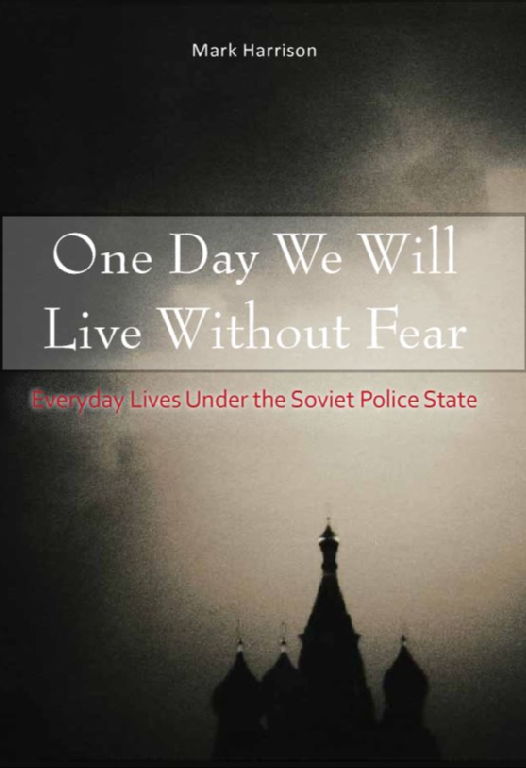
What was life in the Soviet Union really like? Through a series of true stories, One Day We Will Live Without Fear describes what people's day-to-day life was like under the regime of the Soviet police state. Drawing on events from the 1930s through the 1970s, Mark Harrison shows how, by accident or design, people became entangled in the workings of Soviet rule. The author outlines the seven principles on which that police state operated during its history, from the Bolshevik revolution of 1917 to the collapse of the Soviet Union in 1991, and illustrates them throughout the book. Well-known people appear in the stories, but the central characters are those who will have been remembered only within their families: a budding artist, an engineer, a pensioner, a government office worker, a teacher, a group of tourists. Those tales, based on historical records, shine a light on the many tragic, funny, and bizarre aspects of Soviet life
One Day We Will Live Without Fear: Everyday Lives Under the Soviet Police State, by Mark Harrison, is published on 2 February 2016 by the Hoover Press in Stanford, California. Order it today from Amazon US or pre-order it from Amazon UK.
Mark Harrison
02 Feb 2016 08:00
| Tags: Communism History Politics Russia
| Comments (0)
| Report a problem
March 23, 2015
Group, then Threaten: How Bad Ideas Move Millions
Writing about web page http://dx.doi.org/10.1098/rsif.2014.0719
I've been thinking: What is it that enables a bad idea suddenly to spread across millions of people? Here are some of the things I have in mind:
- In France the National Front is reported as leading all other parties in current opinion polls, having won barely 10 percent of the vote in the 2007 presidential election.
- In January's general election, nearly 40 percent of Greek voters supported Syriza, compared wtih fewer than 5 percent as recently as 2009.
- Since narrowly rejecting indendence in last year's referendum, Scotland's voters have rallied to the Scottish National Party, support for which is now reported at over than 40 percent compared with less than 20 percent at the last general election.
- Most spectacularly, more than 80 per cent of Russians are regularly reported as thinking Vladimir Putin is doing a great job as their president, compared with around 60 percent two years ago.
I am hardly the first to ask this question. There is plenty of research (e.g. de Bromhead et al. 2013) on the economic conditions that foster political extremism, for example. But how do we get from economic conditions to wrong persuasion, exactly? There is the famous Goebbels quote about the "big lie," which is fine as far as it goes but always makes me think: surely there's more to it than this?
If you tell a lie big enough and keep repeating it, people will eventually come to believe it. The lie can be maintained only for such time as the State can shield the people from the political, economic and/or military consequences of the lie. It thus becomes vitally important for the State to use all of its powers to repress dissent, for the truth is the mortal enemy of the lie, and thus by extension, the truth is the greatest enemy of the State.
But it can't be true of all lies. Don't some lies work better than others? What is it that defines the ones that work? My best answer so far to this question is an analogy, which I know is less than proof. But it's a thought-provoking analogy; see what you think.
Last year some behavioural scientists (Strõmbom et al. 2014) finally explained how to herd sheep. There is a sheepdog, instructed by a shepherd, that does the running around. It turns out that there are just two stages. First, the dog must gather the sheep in a single compact group. Once that is done, the second step is to threaten the group from one side; as a group, the sheep will move away from the threat in the opposite direction. That's all there is to it.
The reason why the first step must come first is also of interest: If the dog threatens the sheep without first gathering them in a group, they will scatter in all directions, and that's not what the shepherd wants.
Anyway, there's the answer: Group, then threaten.
People are not sheep, and this is only an analogy. Nonetheless you probably already worked out how I would read this. The shepherds are the political leaders. The dogs that run around for them are the campaign managers and activists. The human equivalent of gathering sheep in a group is to polarize people around an identity that defines an in-group and an out-group. So Scots (as opposed to the English), Greeks (as opposed to the Germans), Russian speakers (as opposed to the rest). Group them, then threaten them, and they will move.
To see how the threat sets the group in motion we need one more thing, an insight from Ed Glaeser. Glaeser (2005) wanted to explain the conditions under which politicians become merchants of hate. He began with a community that has suffered some kind of collective setback. When that happens, people demand an explanation: Who has done this to us? "Us" means the in-group. Political entrepreneurs, he argued, will compete to supply satisfying stories. Often the most satisfying account is one that blames the in-group's misfortune on the alleged past crimes of some out-group: the English, the bankers, the Muslims, the Jews, or the West.
Not only past crimes, however; Glaeser uses the phrase "past and future crimes." In other words, he maintains, politicians often transform these stories into powerful threats by giving them a predictive slant: This is what they, the enemy, have done to us in the past and this is what they will do again if we don't mobilize to stop them first.
Remember: Group, then threaten. The result is mobilization.
References
- de Bromhead, Alan, Barry Eichengreen, and Kevin H. O'Rourke. 2013. Political Extremism in the 1920s and 1930s: Do German Lessons Generalize? Journal of Economic History 73/2, pp. 371-406. URL https://ideas.repec.org/a/cup/jechis/v73y2013i02p371-406_00.html.
- Glaeser, Edward L. 2005. The Political Economy of Hatred. Quarterly Journal of Economics 120/1, pp. 45-86. URL: https://ideas.repec.org/a/tpr/qjecon/v120y2005i1p45-86.html
- Strömbom, Daniel. Richard P. Mann, Alan M. Wilson, Stephen Hailes, A. Jennifer Morton, David J. T. Sumpter, and Andrew J. King. 2014. Solving the shepherding problem: heuristics for herding autonomous, interacting agents. J. R. Soc. Interface 11: 20140719. URL: http://dx.doi.org/10.1098/rsif.2014.0719.
Mark Harrison
23 Mar 2015 08:00
| Tags: Greece History Politics Russia
| Comments (0)
| Report a problem

 Loading…

